
How to Optimize Your AI Receptionist: Advanced Strategies for 2026
Unlock peak performance, reduce customer friction, and transform your call handling with this comprehensive guide to AI receptionist optimization. Learn actionable strategies to elevate your AI call answering, 24/7 answering service, and overall customer experience.
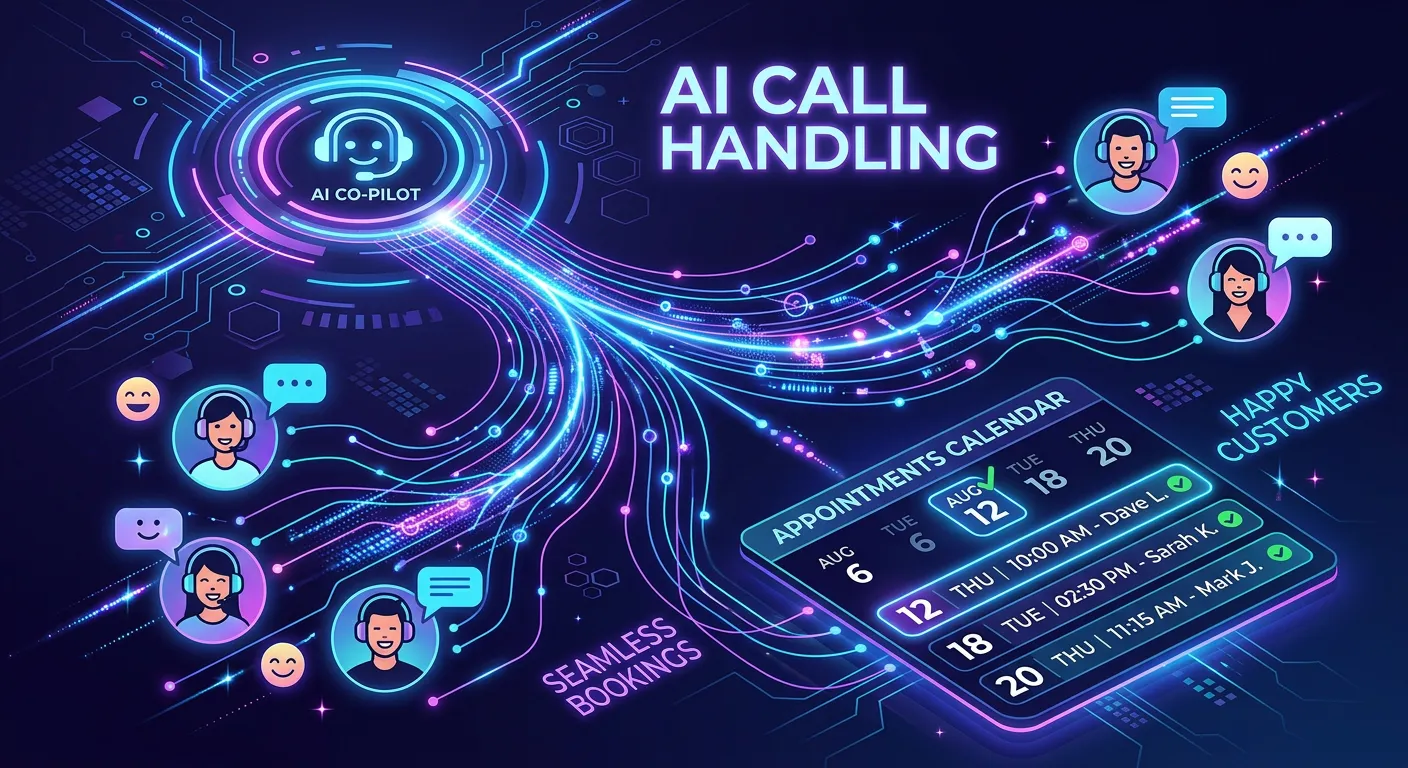
Mastering AI Receptionist Optimization: A Multi-Category Overview
Optimization isn't a one-size-fits-all task. The following interactive guide breaks down the key pillars of a high-performance AI Agent. Use the tabs to explore core focus areas.
Optimizing Voice & Natural Conversation
The foundation of any great AI receptionist is a natural, helpful, and brand-appropriate voice. This goes beyond picking a voice tone.
- Custom Voice Creation: Develop a unique vocal identity. Platforms like CallTaking.ai allow you to craft a voice that matches your brand's personality, moving beyond generic options. Explore how to create a custom AI voice for your business phone for a competitive edge.
- Script Optimization: Write conversational scripts that use open-ended questions ("How can I help you today?") and anticipate common queries. Avoid robotic, yes/no question trees.
- Multilingual Support: For businesses serving diverse communities, a multilingual AI call handling system is no longer a luxury. It's a necessity for capturing every lead.
- Empathy & Tone Adjustment: Program your AI to detect caller urgency or frustration and adjust its tone accordingly, offering reassurance and prioritizing swift resolution paths.
Designing Intelligent Workflows & Smart Routing
An optimized AI doesn't just answer—it understands, qualifies, and directs. This is the core of AI customer service efficiency.
- Dynamic Call Routing: Implement smart, skill-based call routing solutions. Based on the caller's need (e.g.,"billing question,""technical support,""new appointment"), the AI can route them to the correct human agent or department instantly, slashing hold times.
- 24/7 Logic Branches: Configure different workflows for after-hours calls. Your out of hours call answering protocol might focus on emergency contact, appointment booking, or detailed message-taking for next-day callback.
- Appointment Booking Automation: The ultimate optimization. Ensure your AI can directly interface with your calendar (Google, Outlook, practice management software) to book, reschedule, and cancel appointments in real-time. This is a game-changer, as detailed in our guide on automated appointment booking systems.
- Fallback Strategies: Define clear rules for when the AI should transfer to a live human, ensuring complex or sensitive issues are handled appropriately.
Seamless Integration & Data Utilization
A siloed AI is a limited AI. Optimization requires connecting it to your business's central nervous system.
- CRM Integration: Sync call data, caller information, and interaction transcripts directly into your CRM (like Salesforce or HubSpot). This creates a unified customer view.
- Real-Time Transcription & Summaries: Utilize real-time call transcription solutions to provide agents with instant context before they pick up a transferred call, improving resolution speed dramatically.
- Calendar & Booking System Sync: As mentioned, this is critical for service-based businesses like healthcare and legal firms. See how it works for dental practices needing smarter appointment booking.
- Notification Systems: Integrate with Slack, Teams, or SMS to alert teams about urgent calls, missed appointments, or high-priority leads captured after hours.
Continuous Analysis & Performance Tuning
Optimization is a continuous cycle. The best AI receptionist platforms learn and improve over time.
- Call Analytics Dashboard: Regularly review metrics such as call volume, resolution rate, call duration, transfer rate, and caller satisfaction (via post-call surveys).
- Conversation Review: Listen to call recordings where the AI struggled or transferred. Identify patterns and refine scripts, keywords, and intents.
- A/B Testing: Test different greetings, question phrasings, or call routing logic to see which yields higher conversion (e.g., more booked appointments) or better customer feedback.
- Machine Learning Feedback Loops: Choose a platform where the AI's natural language understanding improves based on every interaction, making it smarter autonomously. This is the future of AI call center technology.
Key Benefits of an Optimized AI Receptionist
Implementing these strategies for 2026 delivers tangible, powerful results across your entire business operation.
24/7 Lead Capture & Revenue Protection
An optimized AI acts as your perpetual front desk, eliminating missed calls after hours, during lunch, or in peak times. This directly counters the true cost of missing business calls. It captures every inquiry, schedules appointments, and qualifies leads, turning call overflow into concrete revenue. For strategies, see how to capture leads from missed calls.
Dramatically Improved Customer Experience (CX)
Customers get instant answers, zero hold time for simple queries, and seamless routing for complex ones. A well-optimized AI provides consistency, reduces frustration, and meets the modern expectation for immediate engagement. This is a core component of transforming support with AI-powered customer service. The experience is so smooth that, for many use cases, it challenges the traditional AI receptionist vs. human receptionist debate.
Operational Efficiency & Staff Empowerment
Your team is freed from the repetitive task of call screening and basic Q&A. The AI handles tier-1 support, appointment scheduling, and call routing, allowing human staff to focus on high-value, complex tasks that require empathy and deep expertise. This is a powerful form of automated call handling for a one-person business that scales. It also provides robust healthcare call volume management for busy practices.
Advanced Implementation & Optimization Strategies for 2026
1. Crafting a Powerful AI Call Answering Workflow
The workflow is the brain of your AI call answering system. A poorly designed workflow leads to frustrated callers and missed opportunities. Start by mapping every common caller intent: new inquiries, appointment changes, billing questions, technical support, and emergency contacts. For each intent, design a conversational path that feels natural. Crucially, learn how to build a powerful AI call answering workflow that uses conditional logic. For example, if a caller says"I have a leak," your AI should immediately recognize this as a high-priority plumbing emergency and follow a specific protocol—perhaps asking for location and immediately connecting to an on-call plumber or sending an urgent SMS alert, a system praised in our case study on how a plumbing company stopped missing 20 calls/day.
Pro-Tip: The 3-Question Rule
Aim to qualify and route a caller within three intelligent questions. More than that feels like an interrogation. For instance: 1)"What service do you need today?" 2)"Is this for a new project or an existing account?" 3)"Are you looking to book an appointment or get a quote?" This efficiently gathers essential data for smart routing.
2. Mastering Out-of-Hours & Call Overflow Scenarios
Optimization shines when your team is unavailable. Your out of hours call answering configuration must be distinct from your daytime flow. It should prioritize message detail, emergency contact procedures, and self-service appointment booking. This turns downtime into a lead-generation engine. Furthermore, AI-powered call overflow handling is essential for managing peak times without dropping calls. When all lines are busy, the AI seamlessly answers, queues callers with estimated wait times, or offers a callback option. This transforms a potential customer service failure into a demonstration of professionalism. For a deep dive into managing high-volume periods, explore how CallTaking.ai transforms call volume management solutions.
See Optimization in Action: Machine Learning
Watch how a sophisticated AI receptionist doesn't just follow scripts—it learns from every interaction to become more accurate and helpful over time.
3. Industry-Specific Optimization: Beyond Generic Setups
The best AI receptionist for a law firm is different from the best one for a dental clinic. Tailoring is key:
- Healthcare: HIPAA/GDPR-compliant messaging, integration with EMAR/PMS systems, urgent care triage logic, and automated appointment reminders. Learn why busy healthcare practices are switching to CallTaking.ai and explore AI-powered appointment reminders for healthcare.
- Legal: Confidential intake questionnaires, conflict check inquiries, and routing based on practice area (e.g., family law, personal injury). Legal intake answering for solicitors requires precision and discretion.
- Property & Trades: Emergency dispatch logic, job quoting intake, and scheduling for site visits. A virtual answering service helps UK tradespeople stop missing jobs.
The 2026 Benchmark: What"Optimized" Really Means
By 2026, an optimized AI receptionist won't be a novelty—it will be a baseline expectation. The benchmark will include:
- Zero-Touch Resolution Rate: Over 40% of routine inquiries (appointments, hours, directions) fully resolved by the AI without human transfer.
- Seamless Human Handoff: When a transfer is necessary, the human agent receives a full transcript and summary, so the customer never repeats themselves.
- Predictive Routing: The AI predicts the caller's need based on phone number, time of day, or initial keywords, offering personalized routing before they even ask.
- Omnichannel Memory: The AI's context is shared across phone, web chat, and email, creating a continuous conversation thread.
This level of sophistication is what separates basic answering machines from true business communication transformation.
4. Measuring Success: The KPIs of an Optimized AI Receptionist
You can't optimize what you don't measure. Move beyond simple"call answered" metrics. Key Performance Indicators (KPIs) should include:
| KPI | What It Measures | Optimization Target |
|---|---|---|
| First-Contact Resolution (FCR) Rate | Percentage of calls fully handled by the AI without transfer or follow-up. | Increase month-over-month through script tuning. |
| Caller Satisfaction (CSAT) | Post-call survey scores from callers who interacted with the AI. | Maintain >4.5/5 average. |
| Appointment Conversion Rate | % of calls where the AI successfully books a new appointment. | Maximize by streamlining booking questions and calendar sync. |
| Average Handle Time (AHT) Reduction | Time saved by human agents due to AI pre-qualification. | Demonstrate a clear decrease in AHT for transferred calls. |
Regularly analyzing this data is the feedback loop that powers continuous optimization. It tells you where callers are getting stuck, which intents are misunderstood, and where your live answering services backup is most needed.
Frequently Asked Questions on AI Receptionist Optimization
Answer: Conduct a formal review at least quarterly. However, you should monitor performance analytics weekly. After any major business change (new service, price update, holiday hours) or if you notice a dip in key metrics like First-Contact Resolution, an immediate update is needed. The best systems, like those detailed in our complete guide to AI receptionists, have built-in tools to make these iterative updates simple and fast.
Answer: For highly complex or emotionally charged situations, a human touch is still superior. The optimization goal for these scenarios is not for the AI to"solve" them, but to recognize them quickly and escalate gracefully. By using keyword detection (e.g.,"complaint,""angry,""speak to a manager") and tone analysis, an optimized AI can bypass standard routing, apologize sincerely, and immediately connect the caller to a trained human agent. This is a key part of a balanced comparison between AI and live receptionist services.
Answer:"Set it and forget it." The biggest mistake is treating the AI as a static piece of software rather than a dynamic member of your team that needs training and refinement. Initial setup is just the beginning. Without ongoing optimization based on call data and feedback, performance plateaus and customer experience suffers. The journey from basic setup to peak performance is outlined in resources like optimize your AI receptionist for peak performance & CX.
Answer: Not necessarily. While some advanced integrations may require technical help, the core optimization tasks—script editing, workflow building, reviewing analytics, adjusting call routing rules—are typically managed through user-friendly, no-code dashboards provided by leading services like CallTaking.ai. The process is more about understanding your customer journey and business logic than writing code. You can see this simplicity in action in our guide, "How I Set Up a 24/7 AI Receptionist in 10 Minutes."
Ready to Optimize Your AI Receptionist and Transform Your Call Handling?
Implementing these strategies for 2026 will position your business at the forefront of customer communication. Whether you need a sophisticated AI call center solution or a simple, powerful virtual receptionist for after-hours, the journey starts with a commitment to optimization and the right partner.
For businesses looking to build or enhance their team to manage this new, AI-augmented communication landscape, strategic hiring is key.
Discover why businesses choose CallTaking.ai for the best answering service in the UK and how our platform delivers growth and customer satisfaction.