
Contact Center Services NC II TESDA: Your Ultimate Guide to Hiring Certified Professionals
A comprehensive, SEO-optimized resource for understanding the TESDA Contact Center Services NC II qualification, its impact on modern customer support, and how businesses can leverage this skilled workforce for superior call management.
A Multi-Category Overview of Contact Center Services NC II
What is TESDA Contact Center Services NC II?
The Contact Center Services NC II (National Certificate II) is a technical-vocational program accredited by the Technical Education and Skills Development Authority (TESDA) in the Philippines. It is a foundational certification designed to equip individuals with the essential skills required to perform effectively as customer service representatives, support agents, and contact center professionals in a global BPO (Business Process Outsourcing) environment.
This qualification ensures graduates are proficient in handling inbound and outbound calls, providing customer support, and utilizing core contact center technologies—making them immediately valuable assets for businesses. The certification involves rigorous training in communication, computer literacy, and problem-solving, culminating in a national assessment. For companies, hiring a TESDA-certified agent means bringing on a professional with a validated, standardized skill set, reducing onboarding time and ensuring a baseline of quality in customer interactions.
The Core Competencies of a Certified Agent
The TESDA curriculum is meticulously structured to build competency in three primary areas:
- Communication Skills: Mastery of English communication, including pronunciation, active listening, and professional telephone etiquette. Agents learn to handle diverse customer personalities and de-escalate conflicts.
- Technical & Systems Proficiency: Training in using contact center hardware (headsets, PCs) and software (CRM systems, call logging software, knowledge bases). This is crucial for smart call management and efficient workflow.
- Process Adherence & Problem-Solving: Following standard operating procedures (SOPs), processing customer data accurately, and applying logical techniques to resolve inquiries. This foundational training complements more advanced tools like advanced call automation software.
These competencies ensure that certified professionals are not just answering phones but are actively contributing to customer satisfaction and loyalty—a critical factor whether they are working in a traditional call center or alongside an AI receptionist in a hybrid model.
Transforming the Modern Customer Support Landscape
The proliferation of TESDA-certified professionals has significantly elevated the standards of the Philippine BPO industry, a global leader in contact center services. Businesses worldwide benefit from a ready pool of skilled, English-proficient, and culturally adaptable agents. This certification has become a key hiring differentiator, ensuring a workforce capable of handling complex customer journeys.
In today's landscape, these human skills are increasingly integrated with technology. For instance, while a TESDA NC II agent handles nuanced customer complaints, AI-powered call overflow handling can manage peak volume, ensuring no call is missed. Understanding this synergy is vital; our analysis in this detailed comparison explores how businesses can strategically blend human talent with AI for optimal results.
Key Benefits of Hiring TESDA NC II Certified Staff
Validated Skill Standard
The national certificate is a government-verified guarantee of an agent's core competencies in communication, systems use, and customer service protocols. This reduces hiring risk and training costs significantly.
Enhanced Customer Experience
Certified agents are trained in empathy, active listening, and effective problem resolution. This leads to higher first-call resolution rates, improved customer satisfaction scores (CSAT), and stronger brand loyalty.
Operational Flexibility
These professionals are adaptable to various industries—from healthcare to retail. Their foundational skills allow them to be effectively deployed in hybrid models, working seamlessly with tools like an automated phone receptionist to handle routine queries, freeing them for complex tasks.
Integrating TESDA Talent with Modern AI Call Solutions
The future of contact center services is not a choice between humans and machines, but a strategic integration of both. TESDA NC II certified agents represent the pinnacle of trained human customer service, while AI call-handling solutions provide scalability, consistency, and 24/7 availability. The most successful businesses are those that draw a contact center services drawing a clear map of which tasks are best suited for each.
The Synergy in Action: A Practical Workflow
Consider a healthcare practice experiencing high call volume. An AI-powered system can manage appointment reminders and follow-ups automatically. Meanwhile, inbound calls are initially screened by an AI receptionist, which can handle simple booking inquiries and FAQs. Complex calls—such as a patient discussing nuanced symptoms, billing disputes, or sensitive complaints—are seamlessly escalated to a live, TESDA-certified agent. This agent, skilled in empathy and procedure, provides the human touch that technology cannot replicate. This model is explored in depth in our resource on healthcare call volume management.
Pro-Tip for Business Owners:
When hiring Contact Center Services NC II TESDA graduates, look for candidates who show adaptability and comfort with technology. Their training provides the foundation; their willingness to work alongside AI tools like customizable call answering AI will determine their long-term value in a modern, hybrid customer service operation.
Beyond the Phone: The Expanding Role of the Certified Agent
The contact center services nc ii tesda qualification is evolving. While voice services are core, the curriculum increasingly touches on multi-channel support. Certified agents are prepared to handle email, live chat, and social media interactions, making them versatile omnichannel support specialists. This aligns perfectly with businesses that use AI for initial call filtering but require a human agent to continue the conversation across the customer's preferred platform, ensuring a cohesive journey.
Furthermore, these agents are ideal for managing the output of AI tools. For example, after an AI system provides a real-time call transcription, a certified agent can quickly review it for accuracy, extract key action items, and update the CRM—adding a layer of quality assurance that pure automation may lack.
See the Future of Call Handling
Watch how AI manages high call volumes seamlessly, creating the perfect environment for your skilled TESDA-certified agents to focus on what they do best: building customer relationships.
This demonstration highlights the power of AI to act as a force multiplier for your human team, a concept further explained in our guide on how call taking AI transforms call volume management.
Frequently Asked Questions (FAQ)
A TESDA NC II agent holds a nationally recognized certification that validates a standardized set of skills mandated by the Philippine government. This includes proven competency in communication, computer operations, and industry-specific procedures. A general call center agent may have experience but lacks this formal, government-accredited validation of their core abilities. Hiring a certified agent offers greater assurance of a foundational skill level and professionalism. For more on different service models, see our article on the difference between a call centre and a virtual answering service.
Absolutely. In fact, their structured training makes them excellent candidates for hybrid environments. They are taught to follow processes and use software systems, which translates well to working with AI tools. The AI can handle routine inquiries, call routing, and after-hours coverage (as detailed in this guide on after-hours calls), while the certified agent focuses on complex, high-value interactions that require human judgment, empathy, and problem-solving—maximizing the return on investment for both human and AI resources.
Initially, you may invest in a competitive salary for certified talent, but this is offset by significant long-term savings: Reduced Training Time: They require less onboarding on basics. Higher Productivity: They typically achieve proficiency metrics faster. Lower Attrition: Certified professionals often view their role as a career, not just a job. Improved Outcomes: Better service leads to higher retention and sales. To manage overall costs effectively, pair them with an automated call handling solution for scalability. For a full cost breakdown, review our answering service pricing guide.
The most direct way to access this talent pool is through specialized recruitment agencies in the Philippines or by partnering with TESDA-accredited training institutions. For businesses looking to build a dedicated, high-quality customer service team, posting a job specification that explicitly requires or prefers the NC II certification is crucial. Ready to hire? Start by posting your job requirement here to attract qualified candidates. Additionally, understanding the technological tools that will support them is key; learn how to build a powerful AI call answering workflow to create an optimal working environment.
Build Your World-Class Support Team Today
Leverage the certified excellence of TESDA NC II professionals and augment them with cutting-edge AI call management. This powerful combination is the definitive strategy for achieving unmatched customer satisfaction and operational efficiency.
Explore how our professional AI answering service solutions can create the perfect support ecosystem for your new team.
Case Study: Scaling a Tech Startup with a Hybrid TESDA & AI Model
Consider"NexusTech," a hypothetical but representative SaaS startup experiencing 300% year-over-year growth. Their customer support was buckling under the weight of basic onboarding queries, password resets, and billing questions, which consumed 70% of their agents' time. Complex technical issues were being rushed or placed on hold, leading to a dip in customer satisfaction.
The Challenge
- High volume of repetitive Tier-1 support tickets.
- Lengthy wait times damaging customer perception.
- Skilled agents were underutilized on low-complexity tasks.
- Rapid scaling required a support model that could grow efficiently.
The Hybrid Solution
- Implemented an AI call and chat filter to handle all initial inquiries.
- Hired a core team of TESDA NC II certified agents for escalated support.
- AI was trained to resolve 40% of queries (password resets, plan info) automatically.
- Complex issues were routed to certified agents with full context and call history.
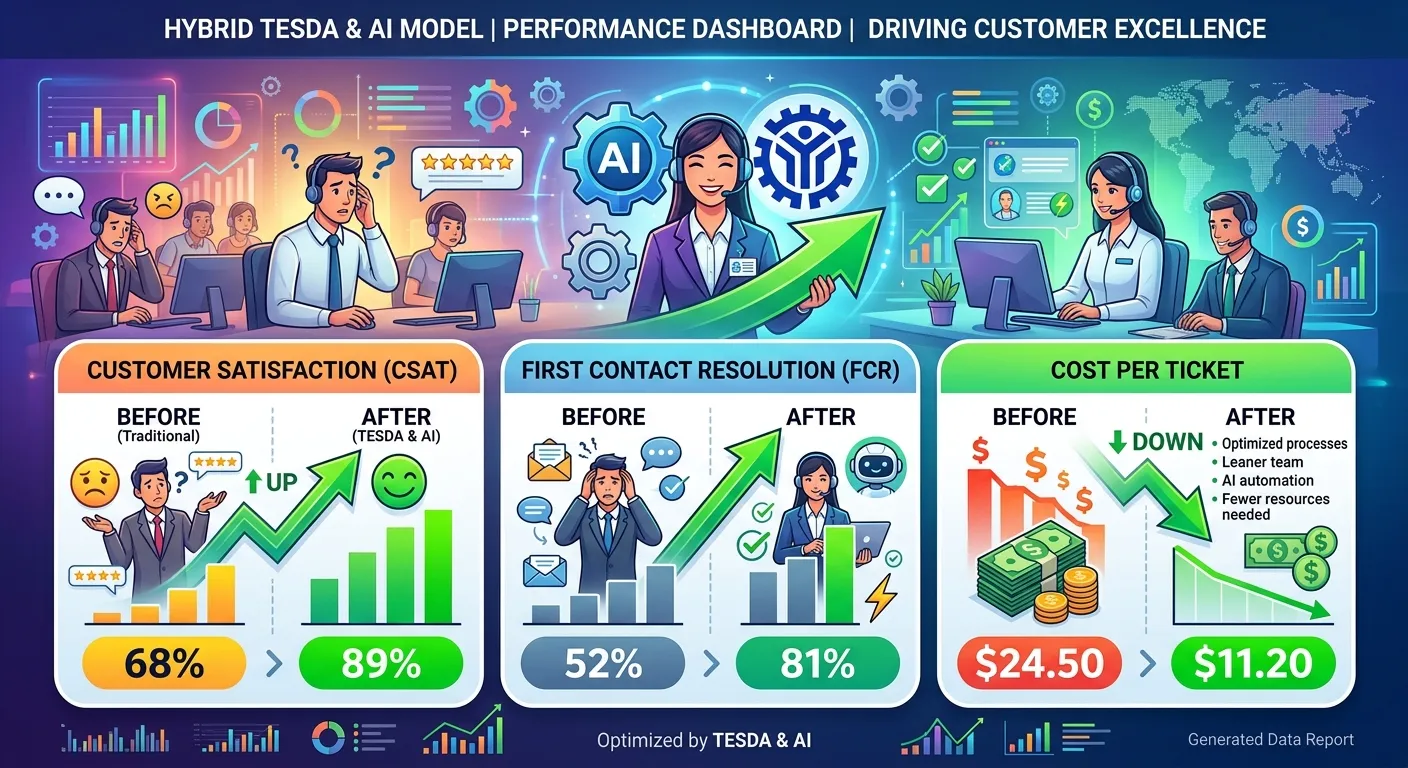
The results were transformative within 90 days: First-contact resolution for complex issues rose by 55%, as certified agents now had the time and mental bandwidth to delve deep. Customer Satisfaction (CSAT) scores increased by 35 points. Critically, the cost per resolved ticket fell by 30%, as the AI managed the bulk of simple interactions. This case underscores the principle that TESDA agents provide maximum ROI when strategically positioned to handle the work that most requires human intelligence and empathy.
Inside the TESDA NC II Curriculum: More Than Just Answering Calls
To fully appreciate the value of a certified professional, it's essential to understand the depth of their 286-hour training program. The curriculum, structured into competency units, goes far beyond script-reading.
Competency Unit 1: Process Inquiries
This isn't just about taking messages. Trainees learn systematic information gathering using techniques like probing questions and paraphrasing to ensure accuracy. They are drilled on data privacy regulations, learning what information can be requested and how it must be securely handled—a critical skill in today's regulatory environment.
Competency Unit 2: Handle Customers Through Telephone
Here, the art of vocal communication is mastered. Trainees undergo rigorous exercises in tone modulation, pacing, and clarity. A key module is emotional intelligence in call handling, where they learn to identify customer frustration, anxiety, or confusion through vocal cues alone and adapt their response accordingly. This unit includes simulated calls with aggressive or distressed"customers," building resilience and de-escalation skills.
Common Competencies: Workplace Professionalism & Tech Skills
Trainees are taught workplace safety procedures (including ergonomics for long desk hours) and team collaboration principles. Their technical training covers not just CRM use, but basic troubleshooting of their own hardware (headsets, computers) and software, minimizing downtime. This foundational tech savvy is what makes them quick to adapt to new platforms, including AI-assisted agent desktops.
A Strategic Hiring Guide: Identifying the Top 10% of NC II Graduates
While the certification guarantees a baseline, businesses should look for candidates who exhibit traits that signal high performance and longevity. Here are key differentiators to seek during the recruitment process:
1. Behavioral Indicators
- Curiosity About Your Business: Top candidates will ask informed questions about your products, services, and customer demographics during the interview. This shows a mindset geared toward understanding, not just processing.
- Examples of Empathy in Action: Ask for specific instances from their training where they dealt with a difficult customer. Listen for descriptions of acknowledging the customer's feelings before jumping to a solution.
- Adaptability Narratives: Inquire about a time they had to learn a new software or process quickly. Their ability to articulate the learning process is telling.
2. Skill & Attitude Assessment
- Tech Comfort Test: Present a scenario involving a common tool like a basic AI call router or a shared knowledge base. Ask how they would use it to solve a problem. Comfort, not expertise, is the initial goal.
- Proactive Problem-Solving: Pose a scenario where a standard procedure fails. Do they focus on who to blame, or do they immediately think of alternative steps to help the customer while escalating the issue?
- Career Vision: Candidates who view this as a step in a customer service or operations career are more likely to be engaged and invest in your company's success long-term.
Implementing a short, role-play interview segment is invaluable. Simulate a call where the"customer" is confused and slightly irritated. Observe not just if the candidate follows a process, but how they establish rapport and control the conversation professionally. This practical test often reveals more than any resume.
The Future Roadmap: Where TESDA NC II is Heading Next
The contact center industry is dynamic, and the TESDA qualification is evolving in response. Understanding these trends allows businesses to future-proof their hiring strategy.
Integration of Digital Channels & Omnichannel Management
Future iterations of the curriculum are expected to heavily integrate social media customer service, live chat etiquette, and email ticket management as core competencies. This will formalize the certified agent's role as an omnichannel specialist. For businesses, this means a single agent can manage a customer who escalates from an AI chatbot to a live call, maintaining full context across platforms—a seamless experience that boosts loyalty.
Data Literacy & Basic Analytics
The next-generation agent will be expected to understand basic support metrics. Training may include interpreting dashboards showing their own performance on Average Handle Time (AHT) or CSAT, fostering a culture of self-improvement and data-driven feedback. This skill turns agents from passive process followers into active participants in operational excellence.
Specialized Tracks for Emerging Industries
We may see the emergence of specialized NC II modules or add-ons for high-growth sectors like FinTech support (understanding basic compliance and fraud detection flags) or HealthTech (managing HIPAA/GDPR-sensitive data with extra care). Hiring agents with these targeted specializations will drastically reduce industry-specific training time.
By hiring TESDA NC II professionals today, you are not just getting a skilled present-day employee; you are investing in a workforce whose foundational training is designed to adapt to the very trends shaping the future of customer service. Pairing this adaptable human talent with scalable AI technology creates a customer support operation that is resilient, efficient, and perpetually modern.