Mastering Contact Center Services: A Complete Guide to the Grade 11 Module for Modern Business Operations
This definitive guide explores the Contact Center Services Module Grade 11 curriculum, its real-world applications, and how AI-powered solutions are revolutionizing the industry. Learn the skills that make professionals indispensable and discover how businesses can leverage this knowledge for superior customer engagement.
Core Components of Contact Center Services Grade 11
This module provides foundational knowledge for managing customer interactions. Navigate the key categories below to understand its scope and modern business applications.
Understanding the Contact Center Services Module Grade 11 Framework
The Contact Center Services Module Grade 11 is a vocational education component designed to equip learners with the theoretical and practical knowledge required to operate within a customer contact environment. It covers the entire customer interaction lifecycle, from first contact to issue resolution and follow-up. Traditionally, this module focused on human-operated call centers, but its principles are now directly applicable to configuring and managing AI-powered answering services that require intelligent workflow design.
Key learning outcomes include understanding different contact center models (inbound, outbound, blended), mastering communication protocols, and learning about performance metrics like Average Handle Time (AHT) and First Contact Resolution (FCR). These metrics are crucial whether you're managing a team or optimizing an automated phone receptionist software.
Pro-Tip for Businesses: The principles taught in Grade 11 modules—like call flow design and customer profiling—are exactly what our experts use when building powerful AI call answering workflows. Understanding these fundamentals allows for more effective implementation of technology.
Critical Skills Developed in the Module
This module builds a multi-faceted skill set that is highly transferable to modern business environments, especially those utilizing hybrid human-AI systems.
- Active Listening & Profiling: Essential for understanding customer intent, a skill critical for training AI to accurately route calls.
- Problem-Solving & Process Adherence: Following defined procedures to resolve issues, mirroring how an AI follows a configured call flow.
- Emotional Intelligence & De-escalation: Managing frustrated callers. While AI handles routine queries, complex emotional situations highlight the continued need for skilled human agents.
- Technical Proficiency & Multitasking: Using CRM software, phone systems, and knowledge bases—skills that translate to overseeing and troubleshooting automated systems.
From Traditional Hardware to AI-Powered Platforms
The module introduces learners to Automatic Call Distributors (ACD), Interactive Voice Response (IVR) systems, and Customer Relationship Management (CRM) platforms. Today, these concepts are the foundation of advanced smart call management solutions. For instance, an understanding of IVR tree design is directly applicable to creating efficient menus in an AI-powered virtual receptionist.
A critical modern application is in Emergency Call Answering Service (ECAS) environments. The module's emphasis on clarity, accuracy, and rapid information processing under pressure is paramount for ECAS operations. Modern AI can assist these services by performing initial caller identification, location triage, and even providing pre-arrival instructions, but the core operational discipline is taught in frameworks like the Grade 11 module.
Career Opportunities and Industry Evolution
Completion of this module opens doors to entry-level positions as Customer Service Representatives, Help Desk Agents, and Contact Center Operatives. However, the landscape is evolving. There is growing demand for roles that bridge human expertise and technology, such as AI Workflow Trainers, Conversational Designers, and Omnichannel Support Analysts.
Businesses seeking talent with these foundational skills should consider hiring staff today who can not only handle calls but also contribute to optimizing automated systems. For example, someone who understands contact center metrics can provide invaluable insights when implementing AI-powered call overflow handling to ensure no customer is ever missed during peak times.
How Module Principles Translate to Modern Business Benefits
The core tenets of the Contact Center Services Module Grade 11 are not academic; they are the blueprint for efficient, scalable, and profitable customer communication in 2026 and beyond.
Structured Call Flow Design
The module teaches logical call handling sequences. This knowledge is critical for businesses setting up an automated call handling system that feels intuitive and resolves queries quickly, reducing caller frustration and operational costs.
Performance Analytics & KPIs
Understanding metrics like Service Level and Customer Satisfaction (CSAT) allows graduates to monitor and improve performance. Businesses can apply this to measure the success of their call center alternative, ensuring their AI receptionist meets key business objectives.
Compliance & Data Security
A key unit covers handling sensitive information securely. This is non-negotiable for sectors like healthcare and legal services. Implementing a secure legal call answering service or an after-hours service for medical offices requires this foundational knowledge of privacy protocols.
Multi-Channel Integration
Modern contact centers are omnichannel. The module's principles apply to email, chat, and social media handling. This holistic view is essential for businesses seeking professional AI answering service solutions that integrate seamlessly with their existing communication stack.
Efficiency & Cost Management
The module emphasizes resource optimization. For a small business, this translates to using an automated answering service for small business to handle routine inquiries 24/7, freeing up human staff for complex, high-value tasks, dramatically improving ROI.
Scalability & Business Growth
Understanding contact center dynamics allows businesses to scale communication effectively. Instead of frantically hiring temporary staff for peak seasons, companies can deploy AI overflow handling to manage unpredictable call surges without compromising service quality.
Emergency Call Answering Service (ECAS): A Critical Application
A specialized and high-stakes area where the Contact Center Services Module Grade 11 principles are vital is in Emergency Call Answering Service (ECAS) operations. These services handle urgent calls for utilities, property management, healthcare, and security firms. The module's training in clear communication, precise data capture, and calm under pressure is directly applicable.
Modern technology augments these human skills. An AI system can be the first point of contact, instantly identifying the caller (via CLI), categorizing the emergency type through keyword detection, and pulling up relevant customer data or property details from integrated systems. It can then immediately connect the caller to the correct on-call engineer or, in less critical cases, schedule a callback. This reduces critical response times. For businesses like plumbing or HVAC, implementing a robust system is the difference between losing a customer and being a hero. Learn more about this in our dedicated guide: How UK Tradespeople Can Stop Missing Jobs.
ECAS Best Practices Derived from Module Training:
- Verification First: Always confirm caller identity and location—a step that can be automated with AI but must be designed into the workflow.
- Triage Protocols: Establishing clear priority levels (e.g., flood vs. dripping tap) ensures resources are dispatched correctly.
- Seamless Handoff: Ensuring all captured information is transferred perfectly to the field operative, eliminating repetition and error.
The AI Advantage in Modern Contact Operations
While the Grade 11 module provides the essential human-centric framework, the industry is rapidly integrating Artificial Intelligence. AI doesn't replace the need for these foundational skills; it amplifies them. For example, a graduate understands the importance of a warm greeting and efficient call routing. An AI receptionist executes this perfectly, 24/7, for thousands of calls simultaneously, applying those same principles consistently.
Consider healthcare call volume management. A human agent trained in the module's principles might handle 50 calls a day effectively. An AI system, built upon those same principles of triage and information capture, can manage initial patient intake for hundreds of calls, freeing the human staff to handle complex care coordination. The result is a hybrid model that is both scalable and personal.
The future lies in professionals who have mastered the Contact Center Services Module Grade 11 curriculum and can apply that knowledge to oversee, train, and optimize AI systems. Businesses looking to build such future-proof teams should start by hiring staff today who possess this crucial blend of traditional knowledge and technological aptitude.
Frequently Asked Questions: Contact Center Services Module Grade 11
Your questions about the module, its relevance, and modern applications, answered.
Absolutely, more than ever. The module teaches the fundamental principles of customer interaction, workflow design, and performance measurement. These are the very rules and logic used to program and train effective AI systems. Understanding why a call flow works a certain way is crucial for configuring an AI that delivers a natural, efficient experience. It's the difference between having a tool and knowing how to wield it expertly. For a deeper dive into this synergy, read our comparison: AI Receptionist vs. Human Receptionist.
ECAS is a high-pressure, high-consequence specialization of contact center work. The Grade 11 module provides the core competency framework: accurate data entry, adherence to strict protocols, clear and calm communication, and efficient triage. An ECAS operator must follow a precise script and process, much like an advanced AI follows a configured workflow. The module instills the discipline required for such critical environments. Businesses running ECAS can enhance their reliability with after-hours call handling solutions that ensure no emergency call goes unanswered.
Yes, immensely. Every business that answers the phone is running a"micro contact center." The principles of professional greeting, need identification, and efficient call resolution apply to a sole trader just as they do to a large bank. For small businesses, applying these principles often means implementing an answering service for startups or an automated system for one-person businesses. The module's teachings help you design what that automated experience should be like to represent your brand professionally and capture every lead.
When hiring for customer-facing or communication management roles, candidates with this module or similar training have a structured understanding of the field. They grasp key concepts like SLAs, CRM usage, and customer journey mapping. This foundational knowledge reduces training time and means they can better collaborate with technical teams to implement tools like advanced call-taking AI. It's a strong indicator of a candidate who sees customer service as a professional discipline, not just a task.
Have more questions? Visit our comprehensive FAQs page for broader insights into AI call answering.
Ready to Apply These Principles to Your Business?
Whether you're looking to hire talent trained in the Contact Center Services Module Grade 11 or want to implement the AI technology that embodies its best practices, the next step is clear.
Explore our transparent pricing or learn how we work to bring efficiency to your customer communications.
Case Study: Module Principles in Action for a Scaling SaaS Company
To understand the tangible impact of the Contact Center Services Grade 11 framework, consider a real-world scenario of a B2B SaaS startup experiencing 300% annual growth. Their customer support was becoming a bottleneck, with long wait times and dropped calls during peak hours. By applying module principles through technology, they transformed their operations.
The Challenge & The Module-Informed Solution
The company's first instinct was to hire more support agents. However, a consultant with a background in contact center training identified the root issue: an inefficient call flow and lack of triage, leading to high Average Handle Time (AHT). Instead of just adding headcount, they first redesigned their customer intake process based on the module's"First Contact Resolution" and"Call Routing" units.
They implemented an AI-powered call routing system that acted as a virtual tier-1 agent. The AI, configured using the logical call flow diagrams central to the Grade 11 curriculum, would ask two key qualifying questions:"What is your role?" (Admin, IT, End-User) and"What best describes your issue?" (Billing, Technical Bug, How-To).
The Result:
- 40% Reduction in AHT: Routine billing queries were handled entirely by the AI with natural language, pulling account data via API.
- Improved Agent Satisfaction: Human agents received pre-qualified, complex technical calls that matched their expertise, making their work more engaging.
- Scalable Foundation: The AI system, built on solid contact center logic, could handle a 500% increase in call volume without additional human cost.
The Technical Blueprint: Module Concepts to System Configuration
This transition wasn't just about buying software; it was about applying learned frameworks. The"Technology & Tools" unit provided the vocabulary and understanding to work with developers. The team mapped their old, chaotic call pattern into a structured decision tree, a direct skill from the module.
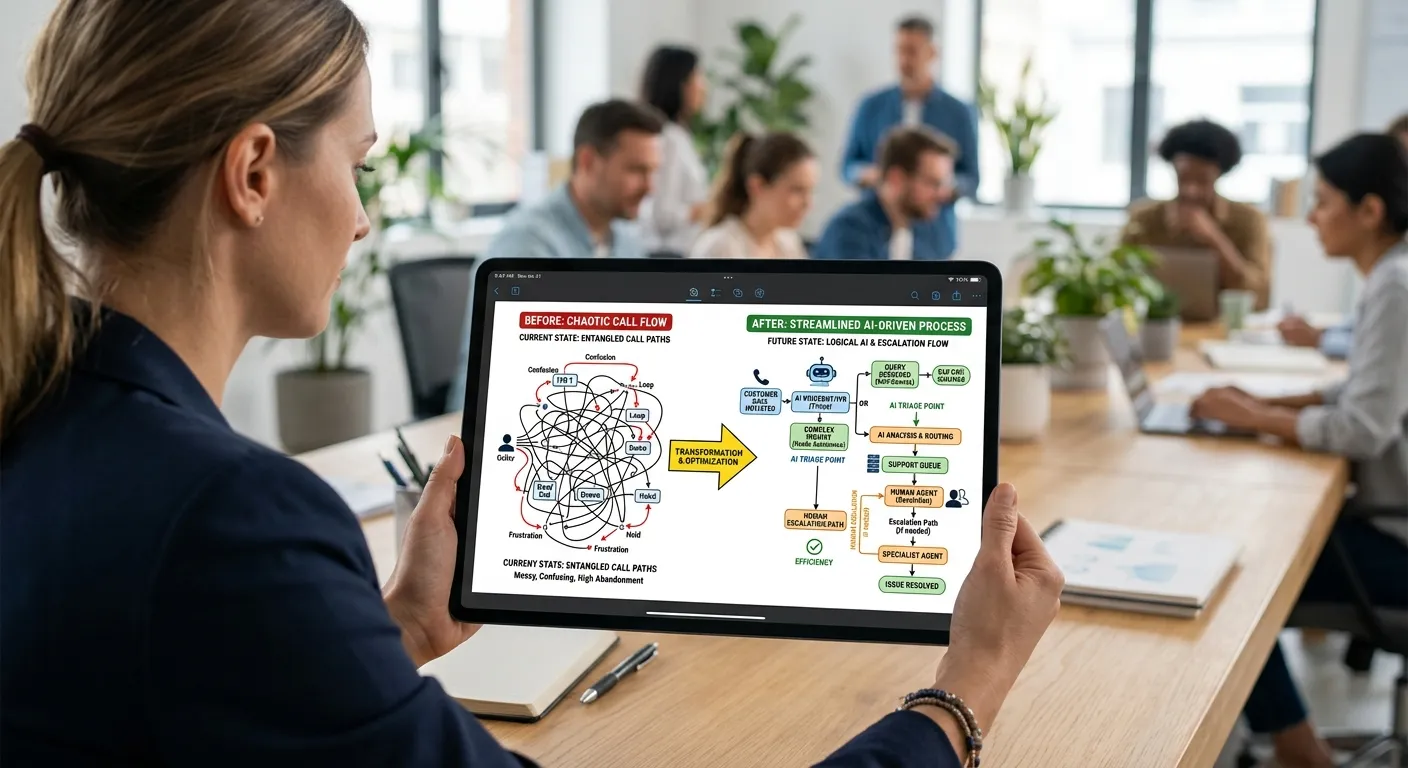
For example, the module's emphasis on"customer profiling" translated into creating specific AI personas. A call identified as coming from an"IT Admin" would immediately be offered advanced troubleshooting options and routed to a senior tech agent if escalated, while an"End-User" would receive simpler, guided solutions. This level of strategic configuration separates a basic auto-attendant from an intelligent smart call management system.
Traditional vs. Modernized Contact Center Skill Application
How the foundational skills from the Grade 11 module evolve and amplify when applied within an AI-augmented business environment.
This evolution highlights the critical shift from performing repetitive tasks to orchestrating and optimizing systems that perform them. The graduate's role becomes more analytical and strategic. They move from asking"How do I solve this customer's problem?" to"How do we design a system that can correctly identify and solve this class of problem for every customer, instantly?" This is the premium value of understanding the core module—it enables professionals to build leverage through technology.
Beyond Logic: The Psychology Embedded in Effective Call Flows
A less obvious but profoundly important aspect of the Contact Center Services module is its implicit teaching of customer psychology. This is the"secret sauce" that makes an AI interaction feel surprisingly human and effective.
1. The Principle of Reduced Cognitive Load
The module teaches agents to ask clear, binary or multiple-choice questions first. This isn't just efficient—it respects the caller's mental effort. A well-designed AI applies this by avoiding open-ended questions like"How can I help?" and instead offering specific options:"Are you calling about a new booking, an existing reservation, or a billing question?" This structures the conversation and accelerates resolution.
2. Managing Caller Anxiety & Building Trust
Training emphasizes tone, reassurance, and setting clear expectations (e.g.,"This may take 2-3 minutes to resolve"). An AI system can be programmed with similar verbal cues:"I've located your account,""I'm connecting you to our specialist now, please hold for just a moment." These micro-interactions, derived from human best practices, prevent caller frustration and abandonment, a key metric (Call Abandonment Rate) covered in the module.
3. The Power of Positive Closure
Every interaction in the module is taught to end with a confirmation and an offer of further help. This leaves a lasting positive impression. An AI call workflow must be designed to do the same—summarizing the action taken, providing a reference, and ending with a branded thank you. This turns a transactional call into a positive brand touchpoint, boosting Customer Satisfaction (CSAT).
Therefore, a professional configuring an AI call answering workflow isn't just dragging and dropping logic nodes. They are architecting a psychological journey. They are deciding when to inject patience, how to phrase confirmations to reduce anxiety, and where to place the most common options to minimize effort. This deep, nuanced application of the module's communication units is what creates a competitive advantage, turning a cost center into a genuine asset for customer retention and brand perception.