The Complete Guide To Modern Help Desk And Support Solutions
Transform customer satisfaction and operational efficiency with intelligent, scalable support systems. Discover how AI-driven help desks and advanced call divert when not answered strategies are redefining service excellence.
Multi-Faceted Help Desk & Support Ecosystem
The Foundation of Modern Customer Service
Today's Help Desk And Support infrastructure is no longer a simple ticket system. It is the central nervous system of customer interaction, integrating omnichannel communication, predictive analytics, and intelligent routing. A robust system ensures no query goes unanswered, directly addressing the critical need for effective call divert when not answered protocols.
Businesses that fail to implement a cohesive strategy face dire consequences, as detailed in our analysis of The True Cost Of Missing Business Calls. The evolution from a basic call center to an integrated support hub is essential for scalability, as explored in The Difference Between a Call Centre and a Virtual Answering Service.
Pro Tip: The First-Contact Resolution Imperative
Design your help desk workflows with the goal of resolving issues on the first interaction. Leverage AI tools to provide agents with instant knowledge base access and caller history, significantly reducing repeat contacts and improving customer satisfaction metrics.
AI-Powered Support: Beyond Automation
Artificial Intelligence is the force multiplier for modern support teams. It handles routine inquiries, provides 24/7 availability, and ensures seamless call divert when not answered to the most appropriate resource—be it a human specialist, a detailed voicemail transcription, or an alternative contact method.
For industries like healthcare, where call volume can be overwhelming, AI transforms operations. Learn how in Healthcare Call Volume Management with Call Taking AI. The power of AI to handle concurrent interactions is unmatched, a capability highlighted in What is an AI Answering Service? (And Why Your Business Needs One).
Building a Scalable Support Strategy
Implementing a help desk is a strategic initiative, not just an IT purchase. It requires careful planning around staffing, technology integration, and process design. For many businesses, the choice between AI and live agents is pivotal. A detailed cost-benefit analysis is available in our Comparison For Businesses Choosing Between AI Call Handling And Live Receptionist Services.
A key strategic element is managing after-hours communication. A dedicated guide on The Easiest Way to Handle After-Hours Business Calls provides actionable steps to capture leads and maintain service levels outside standard hours.
The Future of Help Desk And Support
The trajectory points towards hyper-personalization, predictive support, and deeper integration with business intelligence platforms. AI will move from handling queries to anticipating needs based on user behavior and operational data.
Voice AI will become increasingly nuanced, capable of handling complex emotional cues and multi-step processes. The journey towards this future begins with understanding the tools available today, as outlined in the Complete Guide To AI Receptionists: The Future Of Front Desk.
Core Pillars of a High-Performance Help Desk
Intelligent Call Routing & Diversion
Advanced systems ensure a call divert when not answered is not a failure but a strategic reroute. Calls are dynamically directed based on agent skillset, availability, issue complexity, and customer priority, minimizing hold times and maximizing first-contact resolution.
- Skills-Based Routing
- Failover to AI or Mobile
- Priority Queue Management
Omnichannel Integration & Support
Modern Help Desk And Support unifies phone, email, chat, social media, and SMS into a single agent interface. This provides a 360-degree customer view, preventing repetition and enabling consistent service regardless of entry point.
- Unified Customer History
- Seamless Channel Switching
- Automated Social Listening
AI-Powered Analytics & Insights
Transform raw interaction data into actionable intelligence. AI analyzes call patterns, sentiment, resolution times, and agent performance to identify bottlenecks, predict high-volume periods, and personalize the support experience.
- Real-Time Sentiment Analysis
- Predictive Volume Forecasting
- Automated Performance Reports
Seamless Integration with Business Ecosystems
A modern Help Desk And Support system does not operate in a vacuum. Its true power is unlocked through deep integrations with your existing CRM, calendar, project management, and billing software. This creates a frictionless flow of information.
For example, an AI system can pull customer data from your CRM during a call, or push a newly booked appointment directly into your team's calendar. This level of automation is explored in Powerful And Seamless Integrations. The specific application for appointment-heavy businesses is detailed in Is There An Automated Phone System That Can Actually Book Appointments Directly Into My Calendar?.
Key Integration Points:
- CRM Sync: Automatic ticket creation and customer profile updates.
- Calendar Connectors: Live availability checks and direct booking.
- Internal Communication Tools: Slack or Teams alerts for urgent issues.
- Knowledge Base: AI suggests relevant articles to agents in real-time.
The Role of AI in Overflow & After-Hours
One of the most critical functions of a modern system is managing overflow and after-hours calls intelligently. Instead of a simple voicemail, AI can handle a wide range of queries, capture lead information, and even schedule appointments, ensuring business continuity 24/7.
This is the essence of a robust call divert when not answered strategy. It's not about deflection; it's about capable redirection. Learn about the technology behind this in AI-Powered Call Overflow Handling. For a sector-specific deep dive, see how this transforms medical practices in AI-Powered Appointment Reminder And Follow-Up Calls For Healthcare Businesses.
Scale Your Support CapacityFrequently Asked Questions: Help Desk And Support
Traditional call centers are primarily reactive, voice-centric hubs focused on handling high volumes of inbound calls with human agents. A modern AI-powered help desk is proactive, omnichannel, and intelligence-driven. It integrates AI to automate routine tasks, provide 24/7 self-service, analyze data for insights, and ensure seamless call divert when not answered to the optimal resource. The distinction is explored in depth in our article The Difference Between a Call Centre and a Virtual Answering Service.
Intelligent diversion uses a rules-based engine combined with real-time data. If the primary agent or department doesn't answer within a set number of rings or seconds, the system doesn't just send to voicemail. It can: 1) Check availability of other team members with matching skills. 2) Route to a backup phone number (e.g., a manager's mobile). 3) Divert to an AI assistant that can handle the query, capture information, and create a ticket. 4) Offer a callback option while the caller holds their place in queue. This ensures the caller's intent is captured and acted upon, eliminating the"black hole" of missed calls. This process is a core component of smart call management.
Absolutely. In fact, AI-powered support can be a game-changer for solopreneurs and small teams. It acts as a force multiplier, handling initial inquiries, screening calls, booking appointments, and providing 24/7 coverage without the cost of a full-time employee. This allows the business owner to focus on high-value work while ensuring no lead is missed. For a detailed case study, see Automated Call Handling For One Person Business. The cost-effectiveness is also analyzed in AI Answering Service Vs. Live Virtual Receptionist: Which Is More Cost-effective For A Small Business?.
ROI should be measured across both hard and soft metrics. Hard metrics include: Reduction in average handle time (AHT), increase in first-contact resolution rate, decrease in missed calls/abandoned rate, and reduction in per-contact cost (especially when AI handles Tier-1 queries). Soft metrics include: Customer Satisfaction (CSAT) and Net Promoter Score (NPS) improvements, and improved agent satisfaction and retention. A crucial part of the calculation is quantifying the revenue recovered from calls that would have been missed. Our resource on The Hidden Price Of"Leave A Message": Calculating The Revenue You Lose provides a framework for this analysis.
Ready to Transform Your Help Desk And Support?
Stop losing leads to missed calls and inefficient processes. Implement a scalable, intelligent support solution that grows with your business, ensures seamless call divert when not answered, and delivers exceptional customer experiences 24/7.
Explore our detailed guides: How To Build A Powerful AI Call Answering Workflow and Optimize Your AI Receptionist For Peak Performance & Satisfaction.
Case Studies: The Tangible Impact of Modern Support
Beyond theory, the true value of an intelligent Help Desk And Support system is measured in results. Here are real-world scenarios showcasing transformation across different industries.
Reducing Patient No-Shows & Administrative Burden
A regional clinic with 15 practitioners was struggling with a 25% patient no-show rate and front-desk staff overwhelmed by call volume for appointment confirmations, rescheduling, and basic inquiries.
Solution: Implementation of an AI-powered help desk integrated directly with their Electronic Health Record (EHR) system. The AI handled routine appointment confirmations and reminders via voice and SMS, answered FAQs about clinic hours and preparations, and provided a seamless call divert when not answered to an on-call nurse for urgent medical questions.
Quantifiable Results (6 Months Post-Implementation):
- No-Show Rate Reduced to 8%: Automated, personalized reminders led to a 68% reduction in missed appointments.
- Front-Desk Call Volume Dropped by 40%: Staff could focus on complex patient interactions and in-clinic logistics.
- After-Hours Lead Capture Increased 300%: AI scheduling for new patient consultations outside business hours generated significant new revenue.
This case exemplifies the power of integration and automation in a regulated, high-stakes environment.
Scaling Support During Hyper-Growth Without Adding Headcount
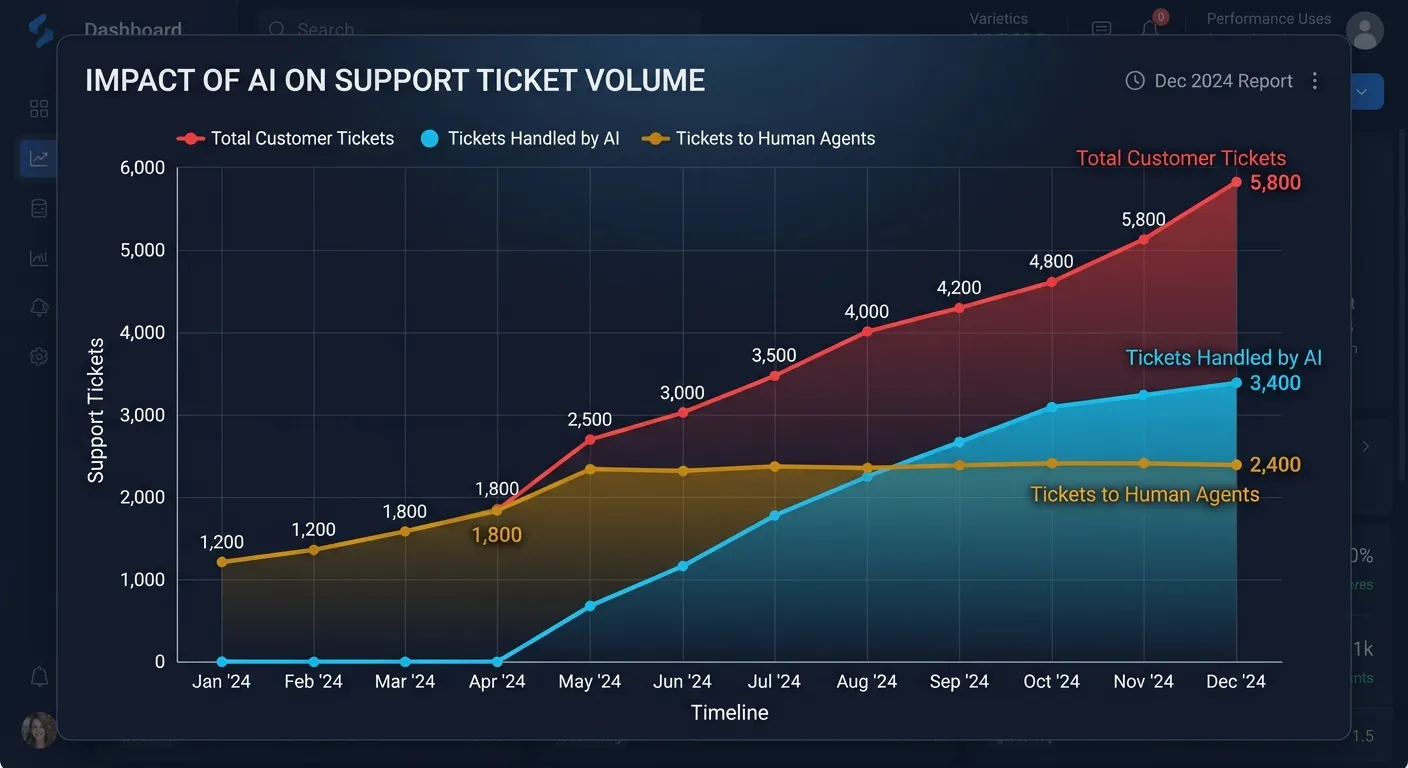
A fast-growing SaaS company experienced a 200% increase in user base over 18 months. Their 5-person support team was drowning in tickets across email, chat, and phone, leading to slow response times and declining customer satisfaction scores.
Solution: Deployment of a multi-tiered AI help desk. Tier 1: An AI chatbot and voice assistant resolved common password resets, billing inquiries, and feature questions by accessing the knowledge base. Tier 2: Complex technical issues were intelligently routed with full context to specialized engineers. A sophisticated call divert when not answered protocol ensured phone calls escalated to the correct team based on the AI's initial diagnosis.
Quantifiable Results (1 Year Post-Implementation):
- First-Contact Resolution Jumped from 45% to 78%: AI provided instant answers for common issues.
- Average Response Time Reduced from 4 hours to 12 minutes: Automated triage and routing slashed wait times.
- Support Team Scalability: Handled 3x the customer load with only one additional hire, focusing on complex, high-value support.
This demonstrates how AI acts as a scalability engine, allowing human talent to focus on where they add the most value.
Under the Hood: Advanced Technologies Powering Modern Help Desks
The seamless experience of a modern support system is powered by a stack of converging technologies. Understanding these components helps in selecting and maximizing your solution.
Natural Language Processing (NLP) & Understanding (NLU)
This is the brain behind AI interactions. Modern NLP goes beyond keyword matching to understand intent, sentiment, and context. For example, a customer saying"My payment didn't go through" and"I was charged but shouldn't have been" are recognized as distinct intents (failed payment vs. disputed charge) and routed differently.
Advanced NLU allows the AI to handle multi-turn conversations, ask clarifying questions, and extract specific data points (like an order number or a date) from unstructured speech or text. This is critical for effective call divert when not answered protocols, as the AI can accurately classify the urgency and nature of a missed call from a brief voicemail.
Predictive Behavioral Routing
This is the next evolution beyond skills-based routing. The system analyzes historical data to predict which agent is most likely to successfully resolve a specific customer's issue. It considers factors like:
- Agent-Customer History: Has this agent successfully helped this customer before?
- Issue Resolution Patterns: Which agents have the highest resolution rate for"billing discrepancy" queries?
- Customer Profile: For a high-value enterprise client, route directly to a dedicated account manager.
This creates a hyper-efficient support flow, reducing handle time and increasing satisfaction by connecting customers with the"right" agent from the first moment.
Real-Time Analytics & Live Dashboards
A modern help desk provides more than retrospective reports. Supervisors have access to live dashboards showing:
- Real-Time Queue Health: Visual alerts for growing wait times or abandoned call spikes.
- Sentiment Tracking: A live feed of customer sentiment scores (positive, neutral, negative) across all channels.
- Agent Activity & Assistance: Identify agents who may be struggling with a particular case type and proactively offer help or knowledge base suggestions.
This enables dynamic resource allocation. If a surge in calls is detected, managers can instantly adjust call divert when not answered rules or bring in additional agents from other projects.
Voice Biometrics & Security
For industries handling sensitive information (finance, healthcare, legal), advanced help desks incorporate voice biometrics. This technology can:
- Authenticate Callers: Verify a customer's identity using their unique voiceprint, replacing or supplementing security questions.
- Prevent Fraud: Detect voice stress patterns or match callers against known fraudster voiceprints.
- Personalize Instantly: Upon verification, the system can immediately pull up the full customer profile, creating a seamless and secure experience.
This layer of security is seamlessly integrated into the call flow, adding protection without adding friction for legitimate customers.
Empowering Your Team: The Human-AI Collaboration
A superior Help Desk And Support system doesn't replace agents; it augments them. The focus shifts from repetitive tasks to complex problem-solving and relationship building.
From Call Handler to Customer Success Advocate
With AI managing Tier 1 inquiries and intelligent routing, human agents are freed to tackle high-value interactions. Their role evolves into that of a Customer Success Advocate, focusing on:
-
Complex Issue Resolution
Deep-dive troubleshooting, escalated technical problems, and nuanced customer negotiations.
-
Proactive Relationship Management
Reaching out to at-risk customers, offering personalized advice, and identifying upsell opportunities based on usage patterns.
-
Knowledge Base Curation
Agents become subject matter experts who refine and expand the AI's knowledge base based on new, complex cases they solve.
This shift leads to higher job satisfaction, reduced burnout, and lower agent turnover—a critical factor in maintaining institutional knowledge and service quality.
AI as a Real-Time Agent Coach
Modern systems provide in-call guidance to agents. As a customer speaks, the AI can:
- Display relevant knowledge base articles or past tickets in real-time.
- Suggest next-best actions or script prompts based on the conversation's context.
- Analyze the agent's tone and pace, offering private, post-call feedback on communication style.
- Warn if a conversation is trending negative, allowing the agent to adjust strategy.
This turns every interaction into a training opportunity, consistently elevating the entire team's performance and ensuring a unified, high-quality customer experience.