Automated Medical Answering Services: The 2026 Guide to Hiring Seamless Patient Communication
Discover how intelligent AI call handling is transforming healthcare administration, reducing missed calls by 99%, and freeing clinical staff to focus on patient care. Learn how to implement a cost-effective solution today.
The Complete Overview of Automated Medical Answering
Defining the Modern Automated Medical Answering Service
An Automated Medical Answering Service is a sophisticated AI-powered telephony system designed specifically for healthcare providers. It goes far beyond simple voicemail or basic IVR menus. This technology uses natural language processing (NLP) and machine learning to understand patient inquiries, triage calls based on urgency, schedule appointments directly into practice management software, provide basic information, and capture detailed intake information—all without human intervention, 24 hours a day, 7 days a week.
Unlike traditional call centres or virtual answering services, these AI systems offer unparalleled consistency, scalability, and data integration. They are a critical component of modern healthcare call volume management, transforming the front desk from a cost centre into a streamlined patient engagement hub.
Pro Tip: The most advanced services, like those detailed in our Complete Guide to AI Receptionists, can handle complex workflows such as prescription refill requests, lab result inquiries, and post-operative follow-up calls, seamlessly integrating with your EHR system.
Transformational Benefits for Healthcare Practices
The shift to automated answering delivers measurable ROI across clinical and administrative functions. The primary benefit is the elimination of the true cost of missed calls, which for a medical practice can mean lost patients, delayed care, and revenue leakage.
- 24/7 Patient Access: Never miss an after-hours emergency or new patient inquiry. This solves the classic problem outlined in The Easiest Way to Handle After-Hours Business Calls.
- Dramatically Reduced Administrative Burden: Free nurses and receptionists from phone tag, allowing them to focus on in-person patient care and complex tasks.
- Improved Patient Satisfaction: Instant answers, zero hold times, and the ability to schedule or cancel appointments anytime reduce frustration and build trust.
- Enhanced Data Accuracy & Compliance: AI captures information consistently, reducing errors, and can be configured for HIPAA/GDPR compliance, with all call logs and transcripts securely stored.
- Scalability During Peak Times: The system can handle an infinite call queue during flu season or pandemic surges without dropping a single call, a key feature of AI-powered call overflow handling.
A Step-by-Step Implementation Roadmap
Successfully deploying an Automated Medical Answering Service requires careful planning. The process is simpler than hiring new staff, as shown in our guide on how to set up AI phone answering.
- Needs Assessment & Workflow Mapping: Document all current call types (appointments, billing, clinical questions, emergencies). Define your ideal call flow and escalation paths to live staff.
- Platform Selection: Choose a provider with healthcare-specific expertise, robust security, and seamless integration capabilities like powerful and seamless integrations with your PMS/EHR.
- Customization & Training: Work with the provider to train the AI on your practice's specific terminology, provider names, service offerings, and protocols. Set up personalized welcome greetings.
- Staged Go-Live & Staff Training: Pilot the system with a single phone line or during specific hours. Train your clinical team on how to receive and action the AI-generated alerts and summaries.
- Monitor, Optimize, and Scale: Review call transcripts and analytics weekly. Fine-tune responses and workflows for continuous improvement, a process detailed in optimizing your AI receptionist.
Key Features & Benefits of Modern Automated Medical Answering
These are not just answering machines; they are intelligent patient communication hubs built for the demands of modern healthcare.
24/7/365 Patient Triage & Intake
AI systems can instantly assess caller intent, ask clinically relevant intake questions, and triage calls based on urgency. Emergency calls can be patched through immediately, while routine appointment requests are handled autonomously. This ensures patients get the right level of attention at the right time, day or night, directly addressing the challenge of capturing leads after hours.
Direct Calendar Integration & Scheduling
The most powerful feature for operational efficiency. Patients can book, reschedule, or cancel appointments in real-time by speaking naturally to the AI. The system checks provider availability across multiple calendars and books directly into slots, sending confirmations via SMS/email. This eliminates double-booking and manual entry errors. It answers the common question: "Is there a system that can book directly into my calendar?" with a definitive yes.
HIPAA-Compliant Data Security & Transcription
Security is non-negotiable in healthcare. Leading Automated Medical Answering Services operate on encrypted platforms, sign Business Associate Agreements (BAAs), and ensure all data is stored and transmitted securely. Every call is transcribed in real-time, providing a searchable, auditable record that is instantly available to clinical staff, enhancing continuity of care and reducing liability. This aligns with the secure infrastructure discussed in our real-time call transcription guide.
The Financial Case: Cost Savings & ROI Unveiled
When evaluating Automated Medical Answering Services, the financial argument is compelling. It's not just an expense; it's a strategic investment that pays for itself multiple times over. To understand the baseline, review our detailed answering service pricing guide.
Direct Cost Comparison: Hiring a full-time medical receptionist in the UK involves salary, national insurance, pension contributions, training, sick pay, and holiday cover—easily exceeding £30,000 annually per person. An AI service typically costs a fraction of this, often a fixed monthly subscription starting from a few hundred pounds, with no hidden costs. For a detailed breakdown, see our cost-effectiveness comparison.
ROI Drivers Beyond Labour Savings:
- Recaptured Lost Revenue: Eliminating missed calls directly converts to filled appointment slots. As explored in The Hidden Price of"Leave A Message", a single missed new patient call can represent hundreds of pounds in lost lifetime value.
- Increased Staff Productivity: Clinical staff spend less time on the phone and more on billable patient care, increasing practice throughput.
- Reduced Overtime & Burnout: Eliminates the need for staff to stay late to return calls, improving morale and retention.
Sample Monthly Cost-Benefit Analysis
*Illustrative figures for a medium-sized practice. Your savings may vary. For precise planning, consult detailed pricing.
See It in Action: A Healthcare Case Study
Witness how a real medical practice eliminated missed calls and streamlined operations.
This case study demonstrates the practical application of an Automated Medical Answering Service for after-hours coverage, a critical need explained in our guide to the best AI receptionist for after-hours calls.
Frequently Asked Questions About Automated Medical Answering Services
Get clear, expert answers to the most common questions healthcare providers have.
Quite the opposite. Modern AI is designed for natural, empathetic conversation. Patients appreciate the immediate answer, zero hold time, and 24/7 availability. The AI can be programmed with a warm, professional tone and is infinitely patient. It handles routine tasks efficiently, allowing your human staff to dedicate more quality time to complex or sensitive patient interactions when needed. For a deeper dive into this dynamic, read AI Receptionist vs. Human Receptionist: The Surprising Winner.
A well-configured system has clear escalation protocols. It is trained to recognize keywords indicating an emergency (e.g.,"chest pain,""can't breathe") and can immediately connect the caller to an on-call clinician or provide instructions to call 999. For non-urgent but complex clinical questions, the AI gathers all relevant information (symptoms, duration, patient history) and creates a detailed, structured note that is instantly forwarded to the appropriate clinical team for callback. This intelligent triage is a core part of smart call management.
No. Reputable providers handle the heavy technical lifting. Setup typically involves a consultation to map your workflows, followed by the provider configuring the AI, setting up call forwarding (which is often as simple as changing a setting on your phone line), and integrating with your calendar. Your staff's main task is providing information (provider names, services, FAQs). The process is designed to be seamless, as outlined in The Future is Here: Setting Up Your Digital Receptionist. Most practices go live in a matter of days, not weeks.
This is a critical question. Leading Automated Medical Answering Services offer robust integration capabilities via APIs, webhooks, or direct partnerships with major PMS/EHR vendors (like SystmOne, EMIS, Vision, or specialist dental/optometry software). During your selection process, confirm the provider's experience with your specific software. Seamless integration is what transforms the AI from a simple answering machine into a central nervous system for patient communication, a key advantage highlighted in our features overview.
Have more questions? Visit our comprehensive FAQs page or contact our team for a personalised consultation.
Ready to Transform Your Patient Communication?
Stop losing patients to busy signals and voicemail. Implement a cutting-edge, cost-effective Automated Medical Answering Service that works tirelessly to support your practice and your patients. The future of healthcare administration is automated, intelligent, and patient-centric.
Take the first step towards seamless healthcare call volume management. Explore why busy healthcare practices are switching, or learn about AI-powered appointment reminders to enhance your entire patient journey.
Real-World Impact: A Cardiology Clinic's 90-Day Transformation
Beyond theory, here is a granular look at how a UK-based cardiology practice with six consultants implemented an automated answering service and measured the results.
The Challenge
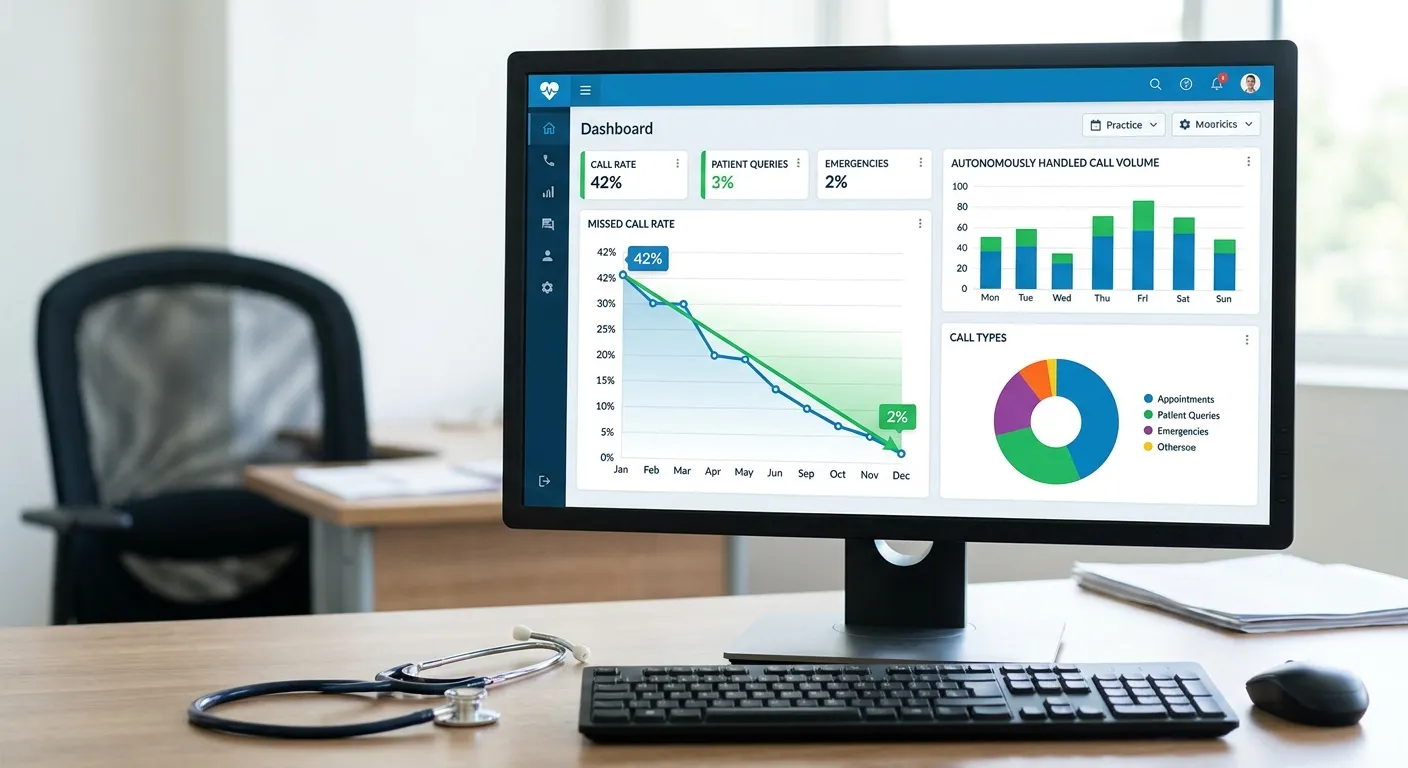
The clinic faced a 42% missed call rate during peak morning hours (8-10 AM). Receptionists were overwhelmed, leading to patient complaints, consultant interruptions for basic scheduling, and a backlog of 50+ callback messages daily. New patient inquiries often went unanswered for over 48 hours.
The Solution Deployed
They implemented a HIPAA-compliant AI service with specific workflows for: urgent symptom triage (e.g.,"chest pain"), routine appointment management, medication query routing, and insurance/billing questions. Integration was established with their EMIS EHR for direct appointment booking and patient record lookup.
Key Results at 90 Days
- Missed call rate dropped to under 2%.
- Average call answer time: 3 seconds, 24/7.
- 31% of all appointments were booked autonomously by the AI outside clinic hours.
- Receptionist time spent on phone administration reduced by 70%.
Clinic Manager's Insight:"The most unexpected benefit was the quality of the call transcripts. The AI's structured notes for medication queries were more consistent and complete than our manual ones, reducing clinical risk. It transformed our on-call process; consultants now receive concise, actionable alerts instead of vague messages." This aligns with the advanced data handling seen in professional call transcription solutions.
Navigating Concerns: Avoiding Implementation Pitfalls
Adoption hesitancy often stems from understandable concerns. Here’s how leading practices successfully address them.
Objection:"We Have Unique, Complex Workflows"
Every practice is different. The key is selecting a provider that offers deep customization, not an off-the-shelf product.
- Solution – Phased Configuration: Start by automating your most common, repetitive call types (appointment changes, hours directions, prescription refill requests). This delivers quick wins and builds confidence. Gradually layer in more complex pathways, such as pre-operative instructions or specific chronic disease management follow-ups.
- Solution – Clinical Oversight Panel: Form a small team of a clinician, an administrator, and the AI provider's consultant to review and approve all medical triage logic and messaging before go-live, ensuring clinical safety and appropriateness.
Objection:"Data Security & Compliance is Our Top Priority"
This is non-negotiable. Due diligence is critical.
- Solution – The BAA & Audit Trail: Insist on a signed Business Associate Agreement (BAA) that clearly outlines data handling, breach notification protocols, and liability. Ensure the provider offers a full audit trail for every call—recording, transcript, and action taken—stored in the UK/EU on encrypted servers. Verify their compliance with frameworks like NHS Digital's Data Security and Protection Toolkit (DSPT) if applicable.
- Solution – Data Minimization: Configure the AI to collect only the information necessary for the task. For a billing query, it may need a patient ID and nature of the issue, but not full medical history. This principle reduces risk surface area.
Objection:"Our Staff Fear Job Displacement"
Change management is essential. The goal is augmentation, not replacement.
- Solution – Role Redefinition & Upskilling: Communicate clearly that the AI handles the repetitive, transactional calls. This frees your team to engage in higher-value activities: complex patient coordination, in-depth patient education at the front desk, proactive care management, and improving the in-clinic experience. Frame it as a tool that removes their most frustrating tasks.
- Solution – Involve Them in the Process: Have frontline staff participate in workflow mapping and testing. Their insights are invaluable for creating a natural system, and their buy-in is crucial for success. They become power users who manage and optimize the AI, a more skilled role.
Beyond Answering: The Evolution into Proactive Patient Engagement
The next generation of automated services isn't just reactive; it uses call data intelligence to predict needs and improve population health outcomes.
From Call Logs to Clinical Insights
The aggregate data from thousands of patient calls becomes a powerful analytics resource. By analysing call reason trends, sentiment, and peak demand times, practices can:
- Predict & Prevent No-Shows: Identify patients who frequently reschedule or show patterns of hesitation. The system can automatically trigger more personalised, pre-appointment confirmation calls or SMS reminders, directly addressing a major source of revenue loss.
- Identify Service Gaps: A spike in calls asking about a specific service (e.g.,"Do you offer travel vaccinations?") clearly indicates unmet patient demand or a marketing opportunity.
- Monitor Public Health Trends: Early, anonymised detection of symptom clusters (e.g., increases in"fever and cough" inquiries in a specific postcode) can serve as a community-level early warning system.
Example: Chronic Disease Management Support
Imagine a patient with diabetes. The integrated AI system can be configured to initiate proactive, outbound check-in calls between appointments.
"Hello [Patient Name], this is an automated check-in from [Clinic Name]. How have your blood sugar levels been this week?"
Based on the patient's verbal response, it can schedule a nurse callback, send educational resources, or prompt a prescription review.
All data is logged directly into the patient's EHR, creating a continuous care record and enabling early intervention, reducing the risk of acute complications.
This proactive capability transforms the system from a cost-saving tool into a revenue-generating, care-enhancing asset, as previewed in our feature on AI-powered follow-up calls.