
Transform Your Patient Care: The Definitive Guide to Medical Answering Service Customer Service Excellence
Discover how cutting-edge AI is revolutionizing patient communication, boosting operational efficiency, and delivering unparalleled 24/7 support. Learn the strategies to elevate your practice today.
24/7 Patient Access
Never miss an urgent call, prescription refill request, or appointment inquiry. A dedicated medical answering service ensures patients receive compassionate, timely responses outside business hours, directly impacting patient satisfaction and retention.
HIPAA-Compliant Security
Protecting Protected Health Information (PHI) is non-negotiable. Premium services operate with end-to-end encryption, secure data handling protocols, and rigorous staff training to ensure full compliance, giving you and your patients complete peace of mind.
Dramatic Efficiency Gains
Free your clinical and administrative staff from the constant interruption of the phone. By automating routine inquiries and triaging calls, you enable your team to focus on in-person patient care and complex tasks, significantly boosting practice productivity and morale.
Choosing Your Service Model: AI vs. Live Agents
The AI Revolution in Patient Communication
Modern AI answering services, like those detailed in our guide What is an AI Answering Service? (And Why Your Business Needs One), are transforming medical customer service. They offer infinite scalability, handling 20 calls simultaneously without wait times, and operate 24/7/365 at a fraction of the cost of human staff. These systems can be configured for healthcare call volume management, intelligently routing emergencies, booking appointments directly into your calendar, and sending automated reminders.
Pro-Tip: Start with AI for Triage
Implement an AI agent as your first line of defense. It can handle 80% of routine calls (appointment bookings, office hours, directions) instantly. This filters only the most complex or sensitive calls to your live staff, maximizing their impact and your ROI. For a deep dive on setup, see How To Build A Powerful AI Call Answering Workflow.
The Human Touch: Specialized Live Agents
For situations requiring deep empathy, complex clinical triage, or nuanced patient reassurance, trained live agents are invaluable. A premium service employs agents specifically trained in medical terminology and HIPAA protocols. It's crucial to understand the difference between a call centre and a virtual answering service; the latter provides dedicated, personalized support that feels like an extension of your practice, not a disconnected call center.
The Best of Both Worlds: Intelligent Hybrid Models
The most effective modern strategy combines AI efficiency with human escalation. AI handles initial intake, qualification, and information gathering. If the AI detects urgency, confusion, or a request beyond its scope, it seamlessly transfers the call (with full context) to a live agent. This model ensures cost-effectiveness without sacrificing critical patient care moments. Our detailed comparison for businesses breaks down the ideal use cases for each approach.
Beyond Answering: The Critical Role of Intelligent Triage & Dispatch
Superior medical answering service customer service is not just about taking messages. It's about intelligent call resolution. This involves:
- Clinical Priority Assessment: Determining if a call requires immediate physician attention, a same-day appointment, or routine follow-up.
- Accurate Information Capture: Logging detailed symptoms, medication lists, and patient history for the clinician.
- Seamless Internal Dispatch: Instantly routing the captured information via SMS, email, or direct integration into your EMR/PMS system.
This operational mindset is similar to high-performance dispatch services for trucking companies, where the correct, immediate routing of information is critical to operational success and customer satisfaction. In healthcare, the"cargo" is patient well-being.
The 5-Pillar Framework for Excellence
-
1
Compliance & Security First
BAAs, encryption, and audit trails are non-negotiable foundations.
-
2
Empathetic Communication Protocol
Scripts and training that prioritize patient anxiety and clarity.
-
3
Technology Integration Depth
Direct sync with your calendar, EMR, and internal messaging platforms.
-
4
Performance Analytics & Reporting
Data on call volumes, outcomes, and patient satisfaction to drive improvements.
-
5
Scalability & Redundancy
Systems that grow with your practice and have zero single points of failure.
Implementation Roadmap: From Selection to Go-Live
Needs Assessment & Vendor Selection
Audit your current call patterns. How many calls are missed? What are the peak times? What types of inquiries are most common? Use this data to create a requirements list. Evaluate vendors not just on price, but on their call volume management solutions, security credentials, and integration capabilities. Reviewing answering service pricing explained will help you budget accurately.
Key Questions to Ask:
- Can you sign a Business Associate Agreement (BAA) for HIPAA compliance?
- What is your specific training process for medical call agents?
- Do you offer a trial period or a proof-of-concept demo?
Workflow Design & Integration
Map your ideal patient journey. Define call scripts for AI, escalation paths for live agents, and create templates for messages. This is where you leverage powerful and seamless integrations to connect the service to your practice management software. Configure rules for different scenarios: emergency calls, after-hours inquiries, appointment scheduling, and billing questions.
Integration Checklist:
- Two-way calendar sync for real-time appointment booking.
- Secure API connection to your EMR for patient data lookup.
- Configured notification channels (SMS, Email, Slack) for urgent dispatches.
Staff Training & Change Management
Your in-house team must understand the new system. Train them on how messages are delivered, how to interpret priority flags, and what their new responsibilities are (e.g., checking the message portal regularly). Emphasize that this tool empowers them, not replaces them. For insights on managing this transition, especially for after-hours coverage, our guide on after-hours calls is invaluable.
Training Focus Areas:
- Accessing and navigating the message dashboard or portal.
- Understanding the triage and priority coding system used by the service.
- Protocol for following up on messages within defined timeframes.
Frequently Asked Questions (FAQ)
Yes, but you must choose a provider that is explicitly designed for healthcare. Look for providers who offer a signed Business Associate Agreement (BAA), employ end-to-end encryption for all data (in transit and at rest), and have strict access controls. Reputable services undergo regular security audits. For more on AI security, see our guide: Is CallTaking.ai The Best Answering Service in the UK?
An external service provides 24/7 coverage without the costs of salary, benefits, training, sick leave, or office space. It also offers scalability during flu season or marketing campaigns. For a detailed cost-benefit analysis, we highly recommend reading AI Receptionist vs. Human Receptionist: The Surprising Winner for Small Business. The key is to view it as augmenting your team, not replacing it.
Absolutely. Advanced AI services integrate directly with calendars like Google Calendar, Microsoft Outlook, and major Practice Management Systems. They can book, reschedule, and cancel appointments in real-time. Furthermore, they can power automated appointment reminder and follow-up calls, drastically reducing no-show rates and improving patient outcomes.
A robust service has explicit emergency protocols. AI can be trained to recognize keywords indicating an emergency (e.g.,"chest pain,""can't breathe") and immediately connect the caller to a live agent or a pre-defined on-call physician line. Simultaneously, it can send SMS and email alerts to your designated emergency contacts with the caller's information and the reason for the escalation. This process is as critical as the logistics in dispatch services for trucking companies during a roadside crisis.
Modern cloud-based AI services can be set up in a matter of hours or days, not weeks. The timeline depends on the complexity of your call flows and integrations. For a standard setup, you can be live within 24-48 hours. To see how straightforward it is, explore The Future is Here: Setting Up Your CallTaking.ai Digital Receptionist.
Ready to Transform Your Patient Communication?
Stop losing patients to missed calls and inefficient communication. Invest in a medical answering service customer service solution that enhances care, protects your practice, and fuels growth.
For more insights, explore our resources on why healthcare practices are switching to AI and the true cost of missing business calls.
Advanced Features & Integrations: The Engine of Modern Service
Beyond basic call answering, the most powerful medical answering services function as a central nervous system for your practice's communication. Their value is exponentially increased through deep, two-way integrations and intelligent automation.
EMR/EHR Integration: The Holy Grail of Efficiency
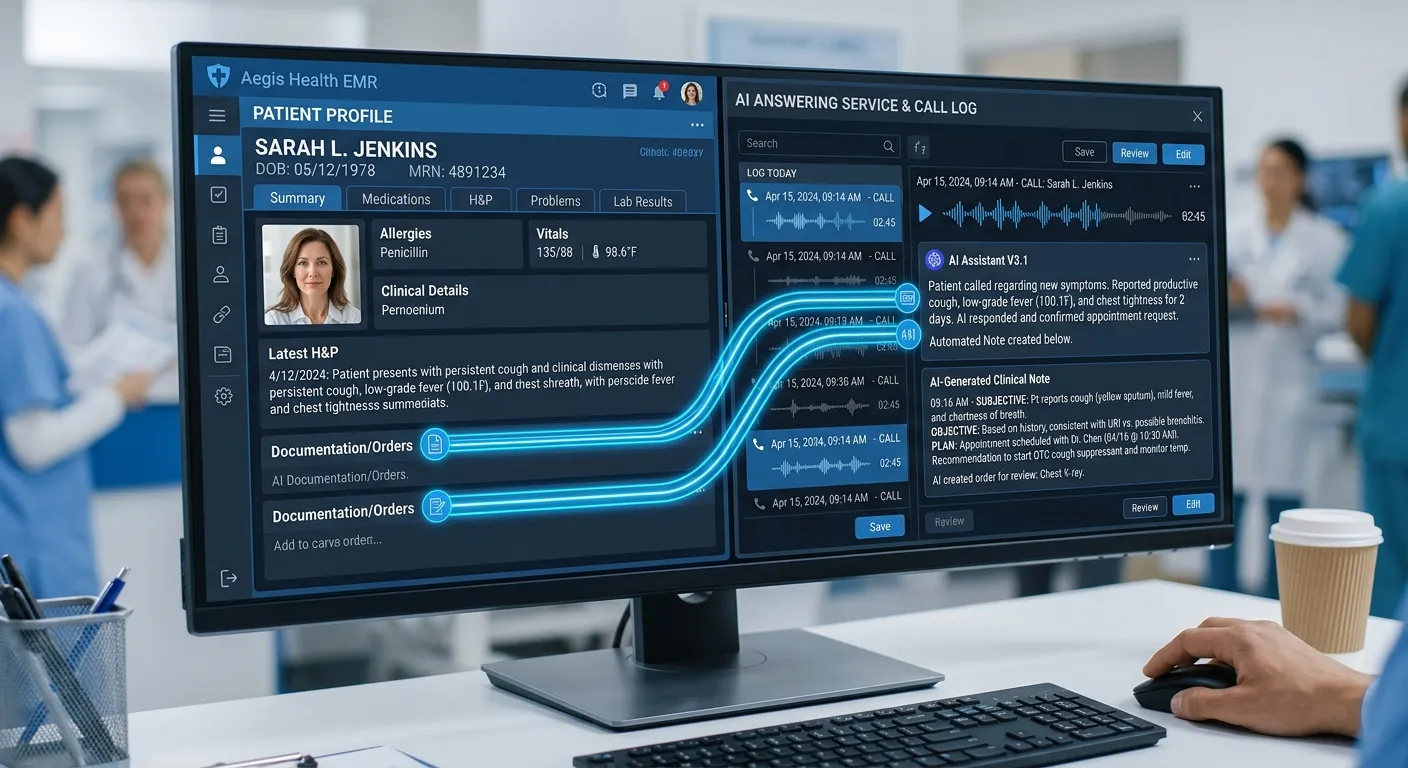
True seamless operation occurs when your answering service can securely read from and write to your Electronic Medical/Health Records system. This allows an AI agent or live operator to:
- Verify Patient Identity & History Instantly: Upon caller ID recognition or verbal confirmation, the system can pull up the patient's chart, providing context for allergies, recent visits, and ongoing treatments before the conversation even deepens.
- Create Direct Clinical Notes: Symptom descriptions, medication refill requests, and call summaries can be logged directly into the patient's record as a structured note, pre-populated for the clinician's review, eliminating double-entry.
- Automate Follow-Up Tasks: A request for a lab result can trigger a task for a nurse. A call about post-op pain can automatically generate a prescription renewal request for doctor approval within the EMR workflow.
This level of integration turns a communication tool into a clinical efficiency tool, reducing administrative burden and minimizing the risk of errors from miscommunication.
Case Study: Multi-Specialty Clinic Reduces Call-Back Time by 70%
A 12-physician clinic integrated their AI answering service with their Epic EMR. Previously, after-hours calls generated paper slips that were manually entered the next morning.
The New Workflow: A patient calls for a prescription refill. The AI verifies them, accesses their medication list via Epic, confirms the dosage, and submits a structured refill request directly into the physician's Epic in-basket. The physician approves it with two clicks at their convenience. The entire process, from call to pharmacy notification, happens in under 15 minutes, often without any staff intervention.
"The integration didn't just save time; it improved patient safety by ensuring all requests were documented accurately in the correct chart from the moment of first contact." – Clinic Practice Manager
Intelligent Omnichannel Communication
Patients communicate through various channels. A top-tier service unifies these touchpoints, creating a single, coherent patient journey.
Confirm appointments, send pre-visit instructions, conduct simple post-discharge check-ins ("On a scale of 1-10, how is your pain?"), and receive photo updates of wounds or rashes, all within a secure, threaded conversation.
When a patient messages via the portal, the service can triage and respond. Conversely, call summaries can be posted to the patient's portal for their records, ensuring continuity and providing a written log of all interactions.
Urgent messages aren't just emailed. They are pushed via Slack, Microsoft Teams, or in-app alerts to the specific on-call clinician's mobile device, with configurable escalation rules if not acknowledged within a set time.
Measuring Success: KPIs & ROI for Medical Answering Services
Implementing a service is an investment. To justify and optimize it, you must track the right metrics. Move beyond vague notions of"better service" to concrete, data-driven outcomes.
The percentage of calls answered live or by AI vs. those sent to voicemail. Target should be near 100%.
Critical for patient satisfaction. AI can achieve this instantly; live agents should be under 30 seconds.
The goal for AI: handling routine inquiries (appointments, hours, directions) without transfer or callback.
A direct financial ROI from automated, multilingual reminder calls and confirmations.
Calculating Tangible Return on Investment
The ROI extends far beyond the monthly service fee. Consider these quantifiable savings and gains:
Cost Avoidance
- Overtime Elimination: No more paying front-desk staff overtime to catch up on messages from missed calls.
- Reduced Physician Burnout: By filtering non-urgent after-hours calls, you protect clinicians' personal time, a key factor in retention.
- Lower Liability Risk: Proper triage and documentation of every call reduces the risk of missed emergencies and associated legal exposure.
Revenue Protection & Growth
- Captured Appointments: Every new patient call that is successfully scheduled (instead of going to voicemail and being lost) represents direct revenue.
- Improved Patient Retention: Superior 24/7 access increases patient satisfaction (Net Promoter Score), directly reducing churn to competing practices.
- Staff Productivity: Reallocating hours previously spent on phone management to revenue-generating tasks like patient education or care coordination.
Specialized Applications & Practice-Specific Considerations
While the core principles apply universally, the optimal configuration of a medical answering service varies dramatically by specialty and practice size.
Primary Care & Pediatrics: High Volume, High Variety
These practices face the widest range of inquiries, from acute sick visits to chronic disease management and wellness. The service must be a master of triage.
- Focus: AI excels here for filtering. It can ask symptom-checker questions to differentiate between a same-day sick visit need and a routine medication question, managing parental anxiety with clear next steps.
- Key Feature: Pediatric-Specific Protocols. The system should have workflows for common calls: fever guidelines by age, advice on when to go to the ER vs. wait for an appointment, and seamless connection to nurse advice lines.
- Integration Priority: Vaccine records and well-child visit schedules to proactively remind parents of upcoming appointments.
Specialist & Surgical Practices: Managing Complexity & Referrals
Calls are often from other physicians or patients with complex, pre-diagnosed conditions. Accuracy and clinical nuance are paramount.
- Focus: A hybrid model is ideal. AI can handle appointment scheduling and intake (collecting referral info, imaging details). Live agents, trained in specialty terminology, are crucial for discussing post-op complications or nuanced symptom changes with patients.
- Key Feature: Referral Packet Management. The service can automatically request referral documents and pre-authorizations from the PCP's office via secure fax or email upon booking a new patient.
- Integration Priority: Surgical block time in the OR schedule and pre-op testing requirements.
Mental & Behavioral Health: Sensitivity & Crisis Management
Confidentiality and empathetic handling of potential crisis situations are the highest priorities. The tone of every interaction is critical.
- Focus: Live agent or highly sophisticated hybrid. AI may be used only for office hours and appointment booking. Live agents require specific training in de-escalation and mental health first aid.
- Key Feature: Discreet Crisis Protocols. Immediate, pre-programmed escalation paths to on-call therapists or national crisis hotlines, with gentle, supportive handoff.
- Integration Priority: Secure messaging to the therapist's private channel, never leaving sensitive information on a front-desk voicemail.
Urgent Care & Emergency: Speed & Life-Threatening Triage
The line between a routine inquiry and an emergency is the core business. The system must err on the side of caution and speed.
- Focus: AI-powered triage with instant live agent override. AI can quickly ask key questions ("Is the patient conscious?""Is there chest pain or difficulty breathing?") to categorize call urgency in seconds.
- Key Feature: Real-Time Wait Time Integration. The answering service should pull live wait-time data from the clinic's queue management system to inform callers and manage expectations, potentially diverting non-urgent cases.
- Integration Priority: Direct connection to ambulance dispatch and ED alert systems for identified critical emergencies.
The Future Horizon: Predictive Analytics & Proactive Care
The next evolution of medical answering services moves from reactive to predictive. By analyzing call pattern data, these systems will begin to:
Using local flu surveillance data and school calendars, the system could alert you to proactively increase staffing or AI capacity next Tuesday.
A patient with CHF who calls three times in a week with shortness of breath questions could be flagged for a proactive care coordinator outreach.
During diabetes awareness month, the system could automatically call at-risk patients with a reminder to schedule their A1c check, booking the appointment if they say yes.
This transforms the answering service from a cost center into a strategic asset for population health management and value-based care delivery.