
Hire Expert After Hours Medical Answering Service Staff
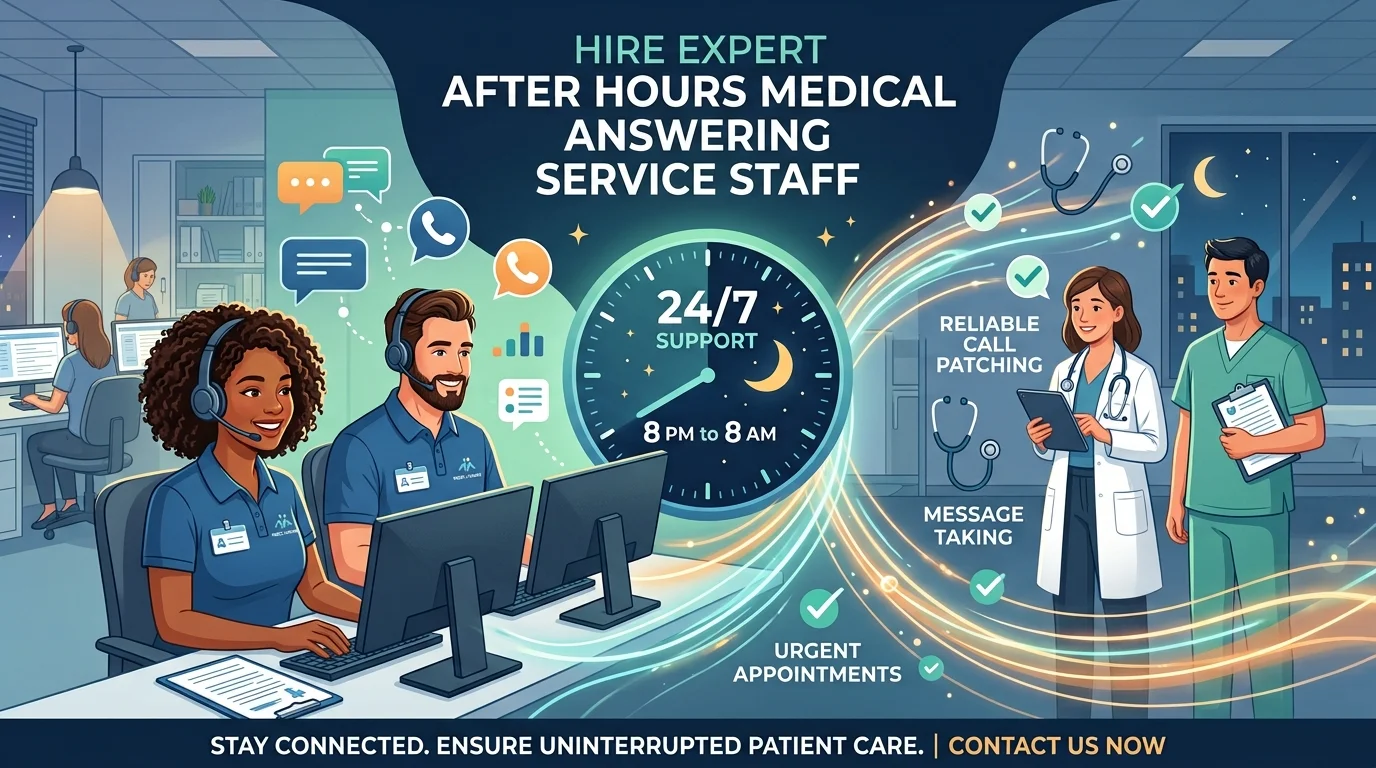
Discover how a dedicated after hours answering service medical practice can transform patient care, protect revenue, and provide indispensable peace of mind for healthcare providers. This comprehensive guide explores the critical features, benefits, and modern AI-powered solutions you need to know.
Hire Expert Call Staff TodayIn the high-stakes world of healthcare, the phone never truly stops ringing. Emergencies don't adhere to a 9-to-5 schedule, patients have questions outside of clinic hours, and critical lab results need to be communicated promptly. An after hours answering service medical practice isn't a luxury; it's a fundamental component of professional, responsible, and sustainable patient care. More than just a message-taking buffer, a modern medical answering service acts as a seamless extension of your practice, ensuring continuity, compliance, and compassion around the clock. This guide delves deep into why every healthcare provider, from solo practitioners to large multi-specialty groups, must evaluate and implement a robust after-hours solution.
Multi-Category Overview: Your After-Hours Toolkit
Choosing the right service requires understanding the different models and technologies available. Explore the categories below to identify the best fit for your practice's specific needs, volume, and budget.
Essential Functionality
A top-tier after hours answering service medical providers rely on must offer more than voicemail. Look for live call screening with custom protocols (e.g.,"Is this an emergency requiring immediate physician contact?"), detailed message capture with specific intake forms for symptoms, medication refills, and appointment requests, and the ability to transfer urgent calls directly to an on-call provider via a secure connection. Integration with your practice management software for automated appointment booking is now a game-changing expectation, not a futuristic dream. For a deeper dive into how technology enables this, explore our guide on How To Build A Powerful AI Call Answering Workflow.
Live Agents vs. AI-Powered Solutions
The traditional model involves a call center staffed by live agents, often specializing in healthcare. This offers a human touch but can be costly and inconsistent. The modern alternative is an AI-powered virtual receptionist, which provides 24/7 consistency, infinite scalability, and often direct integration with calendars and CRMs. The most effective strategy for many practices is a hybrid model: AI handles initial screening, routine inquiries, and appointment booking, while seamlessly escalating true emergencies or complex situations to a live, medically-trained agent or directly to your on-call team. Understand the cost dynamics in our analysis, AI Receptionist vs Live Answering Service 2026: Full Cost Analysis.
HIPAA & GDPR Readiness
This is non-negotiable. Any after hours answering service medical data touches must be fully compliant with regulations like HIPAA in the US or GDPR in the UK. This means Business Associate Agreements (BAAs), end-to-end encryption of calls and messages, secure data storage, and strict access controls. Ensure your provider's compliance is audited and verifiable. For healthcare-specific communication strategies, our resource on Healthcare Call Volume Management with Call Taking AI covers these critical operational and compliance considerations.
Key Benefits of a Medical After-Hours Service
Uninterrupted Patient Care & Safety
Immediate triage ensures true emergencies are flagged and routed with urgency, while non-urgent matters are handled efficiently. This reduces liability and demonstrates a commitment to patient well-being, directly impacting patient satisfaction and trust.
Protect & Grow Practice Revenue
Every missed call is a potential lost patient. An after-hours service captures appointment bookings, medication refill requests, and new patient inquiries 24/7. This turns off-hours into a growth channel. Learn more about quantifying this loss in The True Cost Of Missing Business Calls.
Operational Efficiency & Staff Wellbeing
Free your clinical staff from the burden of managing on-call phones. A dedicated after hours answering service medical team handles the administrative load, allowing doctors, nurses, and administrators to truly disconnect, reduce burnout, and return refreshed. This is a key staff retention tool.
Implementing Your After-Hours Solution: A Step-by-Step Guide
1. Assess Your Needs & Define Protocols
Begin by auditing your current after-hours call volume, types (emergencies, appointments, refills), and pain points. Crucially, establish clear clinical protocols for the answering service: What constitutes an"emergency"? Which calls should be patched through immediately vs. a detailed message? What information must be captured for each call type? Documenting this is the foundation of a successful partnership. For insights into managing high call volumes common in healthcare, see How Call Taking AI Transforms Call Volume Management Solutions.
Pro-Tip:
Involve your clinical team in creating call-handling protocols. Their frontline experience is invaluable for defining accurate triage criteria and ensuring the service reflects your practice's standard of care.
Protocol Checklist:
- Emergency symptom list (e.g., chest pain, shortness of breath).
- On-call schedule management and secure contact instructions.
- Appointment booking rules and calendar integration specs.
- Required patient data fields for each message type.
2. Choose Between Live, AI, or Hybrid Services
This is the critical decision point. Live Agent Services offer human empathy and complex judgment but come with higher costs and potential for inconsistency. AI-Powered Virtual Receptionists offer 24/7 consistency, scalability, and direct software integrations at a typically lower cost, but require careful setup and training. The Hybrid Model is increasingly popular: AI handles initial intake, triage, and routine tasks, escalating only complex or emergency situations to a live medically-trained agent. This balances efficiency with high-touch care where it matters most. To see a hybrid system in action for critical situations, watch our video:
.3. Prioritize Compliance & Security Onboarding
Once you select a provider, the implementation phase is key. Sign a Business Associate Agreement (BAA) if in the US. Ensure their platform uses encryption for data in transit and at rest. Train the service on your specific protocols—this often involves joint training sessions and a testing period with dummy calls. Verify their data centers and security certifications. Your chosen after hours answering service medical partner should be an open book regarding their compliance measures.
4. Launch, Monitor, and Optimize
Go live with a clear communication plan to your patients (update phone tree, website, signage). Closely monitor the first weeks: review call logs, message accuracy, and feedback from your on-call staff. Use this data to refine protocols. A good provider will offer analytics dashboards showing call volumes, outcomes, and response times. Continuous optimization is what separates a good service from a great one. For strategies on fine-tuning performance, read Optimize Your AI Receptionist For Peak Performance & Satisfaction.
FAQs: After Hours Answering Service Medical
Get immediate answers to the most common questions healthcare administrators and practitioners have about implementing an after-hours solution.
Is an after-hours answering service compliant with HIPAA/GDPR?
Yes, but you must choose a provider specifically designed for healthcare compliance. A legitimate after hours answering service medical entity will readily sign a Business Associate Agreement (BAA), utilize end-to-end encryption for all communications, and have stringent data handling policies. Always verify their compliance certifications and audit trails before signing a contract. Never assume a generic answering service meets medical privacy standards.
How do urgent calls get to the on-call doctor or nurse?
Modern services use secure, configurable protocols. Based on your triage instructions, the agent or AI can: 1) Patch the call directly through to the on-call provider's mobile via a secure connection, 2) Send an immediate SMS/Text alert with a callback number, 3) Trigger a priority notification through a dedicated mobile app. You define the escalation path based on the nature of the emergency. This seamless handoff is critical for patient safety.
Can these services actually book appointments directly into our calendar?
Absolutely. Leading AI-powered after hours answering service medical solutions integrate directly with practice management systems like EMIS, SystmOne, or general calendars like Google Calendar and Microsoft Outlook. The virtual receptionist can check real-time availability, book appointments, and even send confirmation texts/emails to patients—all without human intervention. This turns after-hours calls into concrete, revenue-generating bookings. Explore this functionality further in Is There An Automated Phone System That Can Actually Book Appointments Directly Into My Calendar?
What's the typical cost structure?
Pricing varies. Traditional live services often charge per minute of talk time or per call, with higher rates for after-hours. AI-powered services typically use a monthly subscription model based on call volume or features, offering more predictable costs. Some hybrid models combine a low monthly AI fee with a per-incident charge for live agent escalations. Always factor in setup fees, training costs, and any charges for integration. For a detailed breakdown, consult our guide: Answering Service Pricing Explained: What to Expect in the UK.
How quickly can we implement a service?
Implementation time depends on complexity. A basic call-forwarding setup with a live service can be active in 24-48 hours. A fully configured AI virtual receptionist with custom protocols, triage logic, and software integrations can take 1-2 weeks of setup, training, and testing. The most critical path is defining your clinical protocols clearly; a well-documented process allows any provider to implement faster and more accurately.
Stop Losing Patients After Hours. Act Today.
Implementing a reliable after hours answering service medical practice standard is one of the most impactful decisions you can make for patient safety, practice growth, and team morale. Don't let another night or weekend pass with unanswered calls and missed opportunities.
Ready to explore how AI can revolutionize your after-hours communication? Learn more about what an AI Answering Service is and why your business needs one.
Case Study: Transforming a Multi-Specialty Clinic’s After-Hours Operations
To understand the tangible impact, consider the real-world example of"Riverside Medical Group," a practice with 12 physicians across cardiology, internal medicine, and pediatrics. Prior to implementation, their on-call system relied on a rotating mobile phone among physicians, leading to missed calls, physician burnout, and inconsistent patient experiences.
The Challenge
- Average of 42% of after-hours calls went to voicemail, unreported.
- High physician stress and no reliable downtime.
- No mechanism to capture new patient inquiries or bookings after 5 PM.
The Solution
They implemented a hybrid AI-powered after hours answering service medical model with the following configuration:
- AI Virtual Receptionist for initial triage and routine requests.
- Live, medically-trained backup for complex triage and emergency escalations.
- Direct integration with their EMIS system for appointment booking.
The Results (6 Months Later)
- 100% of calls answered live, with 78% resolved by AI without escalation.
- 22 new patient appointments booked after hours per month, directly into the schedule.
- Physician after-hours interruptions reduced by over 80%.
Advanced Features: Beyond Basic Call Answering
Modern medical answering services are sophisticated communication hubs. Here are advanced capabilities that forward-thinking practices are leveraging.
Automated Patient Intake & Triage
AI systems can now conduct structured, conversational interviews with patients calling after hours. Using natural language processing, the system asks symptom-specific questions based on keywords mentioned by the caller (e.g.,"fever,""chest pain,""child"). It then scores the urgency based on clinical protocols you set and either provides self-care advice for low-acuity issues, schedules an appointment, or triggers an immediate escalation. This ensures consistent, protocol-driven triage 24/7, reducing the cognitive load on your live staff.
For instance, a parent calling about a child's fever can be guided through dosage questions for over-the-counter medication and offered the first available appointment slot the next morning, all without a live agent.
Seamless Multi-Channel Integration
The service shouldn't exist in a silo. Top-tier solutions integrate across your practice's entire communication ecosystem:
- Practice Management Software: As mentioned, for real-time appointment booking and access to patient records (with proper security).
- Secure Messaging Platforms: Detailed messages from calls are delivered not just via SMS or email, but directly into secure clinical messaging apps like Signal or dedicated platforms, ensuring PHI safety.
- CRM Systems: New patient inquiries captured after hours are automatically created as leads in your CRM with full call notes, enabling prompt follow-up by your administrative team.
Pitfalls to Avoid When Selecting a Provider
A strategic decision can be undermined by common oversights. Being aware of these pitfalls will guide you to a more successful partnership.
Pitfall #1:
Choosing on Price Alone
The cheapest service may cut corners on security, employ non-specialized agents, or lack reliable technology. In healthcare, a missed emergency call or a data breach has a cost far exceeding any monthly savings.
The Fix: Evaluate total value. Consider the provider's healthcare specialization, compliance guarantees, technology stack, and reporting capabilities. A slightly higher investment in a robust after hours answering service medical partner delivers exponential returns in risk mitigation and patient satisfaction.
Pitfall #2:
Inadequate Protocol Documentation
Assuming the service will"figure it out" or providing vague verbal instructions is a recipe for errors. Inconsistent triage leads to either too many non-urgent calls being patched through (angering physicians) or true emergencies being downgraded (risking patient safety).
The Fix: Invest significant time upfront to create a detailed, written"Call Handling Playbook." This living document should include scripts, decision trees, and explicit examples. Review and update it quarterly with your clinical lead and the service provider.
Pitfall #3:
Neglecting the Patient Experience
A service that is purely functional but lacks empathy can damage your practice's reputation. Patients calling after hours are often anxious. A robotic interaction or being put on hold for a long time can exacerbate their stress and lead them to seek care elsewhere.
The Fix: Test the service yourself. Call the line anonymously. Is the greeting warm and reassuring? Does the AI voice sound natural? Is the hold time minimal? Ensure the provider trains both AI and live agents in"webside manner"—the telephone equivalent of bedside manner. Compassion is a non-negotiable feature.
The Future: Predictive Analytics and Proactive Care
The next evolution of the after hours answering service medical function is shifting from reactive to proactive. By analyzing aggregated, anonymized call data, advanced AI platforms can provide predictive insights to practice administrators.
How Data Informs Smarter Practice Management
-
Seasonal Trend Forecasting
The system can identify that calls for pediatric asthma spike in your region every October, or that flu-related inquiries from adult patients increase sharply in February. This intelligence allows you to proactively adjust on-call staffing, ensure adequate inventory of relevant medications, and even send out pre-emptive patient education materials.
-
Identifying Protocol Gaps
Analytics might reveal a high rate of calls being escalated to a live agent for"medication refill requests" because the AI lacks the logic to handle them. This identifies a training opportunity. Similarly, if a high percentage of calls for a specific symptom (e.g., back pain) result in"advised to go to A&E," it may indicate a need for a new same-day urgent care slot in your schedule.
The Ultimate Goal: Closed-Loop Communication
The future lies in a fully integrated loop: A patient calls after hours, the AI captures symptoms and books an appointment. The next morning, the physician's dashboard is pre-populated with the call notes and triage summary. After the visit, the system can automatically send a follow-up message to check on the patient's progress, completing the circle of care. This transforms the answering service from a message taker into an integral component of the patient journey and clinical workflow.
Key Takeaway:
When evaluating providers, ask about their analytics dashboard and their roadmap for predictive features. A partner invested in innovation will help future-proof your practice's communication strategy.