
Transform Patient Care: The Complete Guide to an After Hours Answering Service Medical Practices Trust
Stop losing critical patient calls, missing emergencies, and sacrificing your personal time. Discover how a professional medical after hours answering service ensures continuous care, protects your practice’s reputation, and boosts patient satisfaction without hiring in-house night staff.
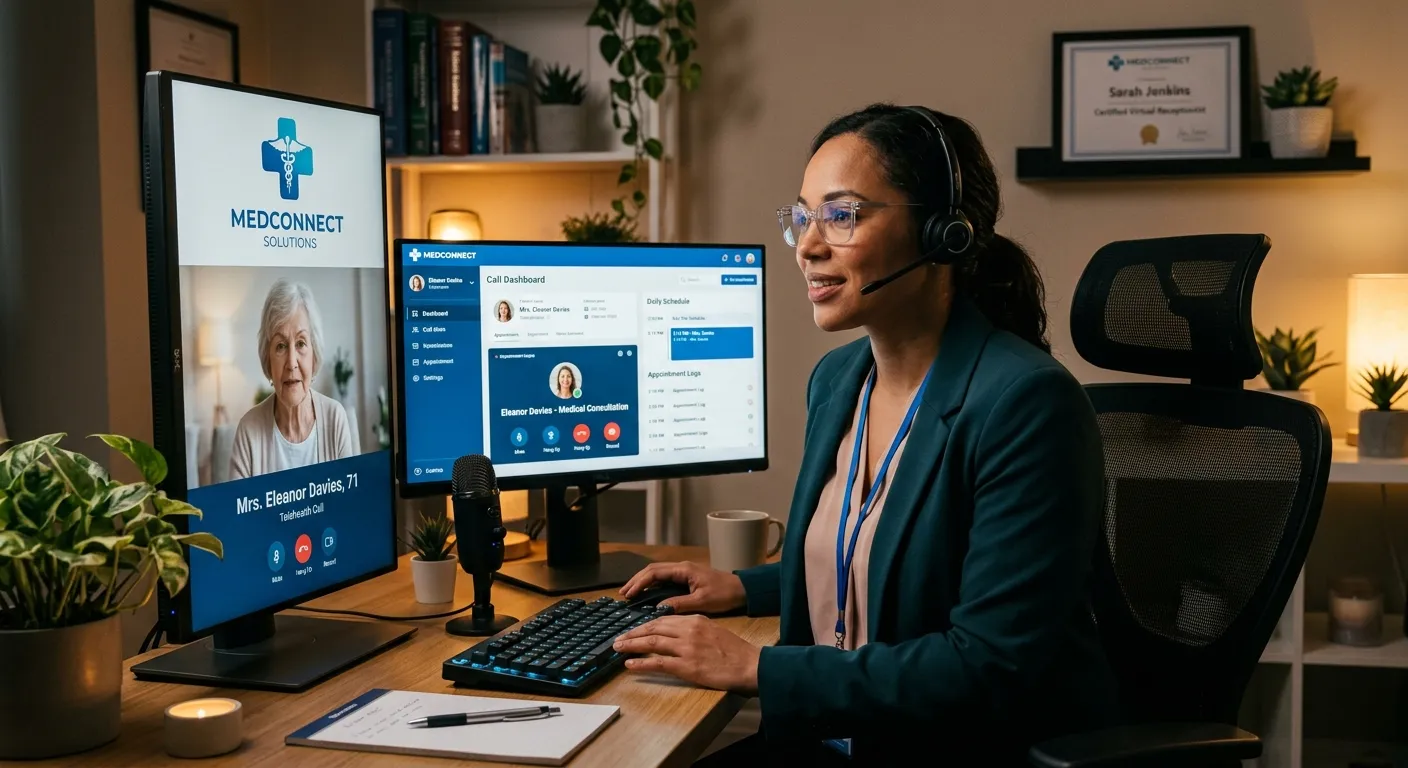 A professional, empathetic female virtual receptionist working on a dual-monitor setup in a modern h...
Choosing Your After Hours Medical Answering Solution
Not all services are created equal. Compare the primary models to find the perfect fit for your practice's size, budget, and compliance needs.
The Future of After-Hours Triage
AI-powered services use sophisticated natural language processing to handle calls 24/7. They can answer FAQs, triage urgency based on symptoms, book appointments directly into your calendar, and forward true emergencies immediately. This model is exceptionally cost-effective and never sleeps.
For a deep dive into how this technology functions, explore our resource on what an AI answering service is and why your business needs one. The key advantage for medical practices is consistent, unbiased, and instant response, eliminating wait times that can escalate patient anxiety after hours.
Pro-Tip: Perfect for High-Volume, Routine Inquiries
Use AI to filter out prescription refill requests, appointment rescheduling, and non-urgent symptom queries. This frees up your live staff (or on-call clinicians) to focus solely on genuine emergencies, dramatically improving response times for critical cases. Learn about healthcare call volume management for strategies.
The Human Touch for Complex Care
A live after hours answering service medical model employs trained, empathetic agents—often with medical terminology training—to handle patient calls. They provide a human connection, expertly navigate sensitive conversations, and use judgment to assess urgency in a way AI is still maturing towards.
This service is ideal for specialties like mental health, palliative care, or pediatrics where empathy and nuanced understanding are paramount. It’s crucial to understand the difference between a call centre and a virtual answering service to ensure you're hiring staff trained for dedicated, personalized support, not just high-volume call processing.
Best of Both Worlds: Efficiency & Escalation
The hybrid model uses AI as the first line of defense, handling the majority of after-hours calls instantly. It then seamlessly escalates calls meeting specific criteria (e.g., keywords like"chest pain,""severe bleeding," or high emotional distress detected in voice tone) to a live agent. This maximizes efficiency while ensuring no critical call is ever handled solely by automation.
This approach is becoming the industry gold standard. For insights on how leading practices are implementing this, see how busy healthcare practices are switching to Call Taking AI to create this seamless, intelligent workflow.
Core Benefits of a Medical After Hours Answering Service
Implementing a dedicated service transforms your after-hours operations from a liability into a strategic asset for patient care and practice growth.
24/7 Emergency Triage & Response
Never miss a true medical emergency. A professional service instantly identifies urgent calls based on predefined protocols and connects patients to the on-call physician or emergency services immediately, creating a reliable safety net for your patients and legal protection for your practice.
HIPAA/ GDPR Compliant Security
Top-tier services are built with healthcare-grade security. Ensure your chosen provider offers encrypted call handling, secure message delivery, and signed Business Associate Agreements (BAAs) to safeguard Protected Health Information (PHI) and comply with regulations, avoiding costly violations.
Uninterrupted Clinician Off-Hours
Restore work-life balance for your doctors and nurses. By filtering out non-urgent calls, an after hours answering service ensures on-call staff are only disturbed for genuine emergencies, leading to reduced burnout, higher job satisfaction, and better care during their active shifts.
Captured Revenue & Reduced No-Shows
After-hours calls are often new patients seeking care or current patients needing to reschedule. A service can book appointments directly into your calendar, send automated reminders, and capture patient details, turning missed calls into filled slots. Understand the true cost of missed calls to quantify the ROI.
Enhanced Patient Satisfaction & Loyalty
Simply being heard outside of office hours builds immense trust and loyalty. Patients feel cared for and valued, which directly impacts online reviews, practice reputation, and patient retention rates in a competitive healthcare landscape.
Cost-Effective vs. In-House Staff
Hiring, training, and managing overnight in-house receptionists is prohibitively expensive. An outsourced after hours answering service medical solution provides 24/7 coverage at a fraction of the cost, with no overhead for benefits, sick pay, or infrastructure. For a detailed analysis, watch our AI receptionist demo to see efficiency in action.
Implementing Your After Hours Service: A Step-by-Step Guide
A successful rollout requires careful planning. Follow this actionable roadmap to ensure seamless integration with your existing workflows and maximum benefit from day one.
Audit & Define Your Current After-Hours Landscape
Begin by analyzing 3-6 months of after-hours call data. How many calls do you receive? What are the most common reasons (appointment booking, refills, symptoms, emergencies)? What percentage required immediate physician contact? This data is crucial for configuring your service's triage protocols and choosing between AI, live, or hybrid models. A tool like smart call management analytics can provide these insights instantly.
Actionable Task: Create a call reason checklist and map each to a desired outcome (e.g.,"Appointment Request" -> Book into calendar;"Severe Abdominal Pain" -> Immediate call transfer to on-call doctor).
Select a Compliant Provider & Configure Workflows
Vet providers rigorously on HIPAA/GDPR compliance, security certifications, and experience in the medical field. Once selected, work closely with their onboarding team to build your custom call flow. This includes:
- Greeting & Identification: A professional opening that confirms the caller has reached your practice.
- Triage Scripts: Key questions to assess urgency based on your specialty.
- Escalation Pathways: Clear rules for which calls go to which on-call clinician, and when to advise calling 999/911.
- Integration Setup: Connect the service to your PMS for appointment booking and to your secure messaging platform (e.g., SMS, email) for alerts.
Explore how to build a powerful AI call answering workflow for technical guidance.
See the Hybrid Model in Action
Watch how an intelligent after hours answering service medical solution instantly triages a call and escalates a potential emergency to a live agent.
Train Your Team & Communicate the Change
Internal buy-in is critical. Train all clinical and administrative staff on the new process:
- On-Call Clinicians: How they will receive alerts (call, text), what information the service will provide, and their response responsibilities.
- Front Desk: How to handle patient inquiries about the new after-hours system and how to access the message portal in the morning.
Patient Communication: Proactively inform patients via website banners, waiting room signage, appointment confirmation emails, and social media posts. A smooth transition builds confidence. For more on transforming communication, read about transforming business communication through smart outsourced answering.
After Hours Answering Service Medical: FAQs
Answers to the most common questions from practice managers and healthcare providers considering an after-hours solution.
Is an AI-powered service appropriate for sensitive medical calls?
Modern AI medical answering services are designed with sensitivity and compliance in mind. They use pre-approved, empathetic scripts and are excellent for initial intake, triaging based on symptoms, and handling routine requests. For highly sensitive situations or when a caller is distressed, a well-configured hybrid system will automatically escalate to a trained live agent. The key is choosing a provider that allows for this nuanced configuration, ensuring the human touch is available when needed most. Our comparison on AI vs. live virtual receptionist cost-effectiveness delves deeper into this balance.
How do we ensure HIPAA/GDPR compliance with an external service?
Compliance is non-negotiable. Reputable providers will:
- Sign a formal Business Associate Agreement (BAA) or Data Processing Agreement (DPA), assuming liability for protecting PHI.
- Employ end-to-end encryption for all calls and messages.
- Use secure, audited data centers and ensure all staff handling medical data undergo specific HIPAA/GDPR training.
- Provide detailed documentation of their security policies. Always request and verify these documents before signing a contract.
Can the service book appointments directly into our practice management system?
Yes, this is a core feature of advanced services. Through APIs or secure integrations, both AI and live agents can access real-time availability in your calendar (e.g., SystmOne, EMIS, or even Google Calendar) and book appointments directly. This eliminates manual data entry in the morning and prevents double-booking. The appointment details, along with any notes from the call, are instantly logged. For a real-world example, see how medical appointment booking works for GP surgeries.
What happens if the call volume is unexpectedly high?
A robust service is built to scale. For live services, they should have a pool of trained agents to handle overflow, ensuring no call goes to voicemail. AI-powered services inherently scale instantly, handling thousands of concurrent calls without wait times. This is a significant advantage over an in-house person who can only manage one call at a time. Learn more about this capability in our article on AI-powered call overflow handling.
How quickly can we implement an after hours answering service?
Implementation speed varies by provider and complexity. Simple call forwarding to a live service can be set up in under 24 hours. Configuring a fully customized AI or hybrid workflow with PMS integrations typically takes 2-4 weeks of collaborative setup and testing. Some providers offer remarkably quick turnarounds; for instance, you can learn how to set up a 24/7 AI receptionist in 10 minutes for basic functionality.
Stop Missing Calls. Start Transforming Patient Care.
An optimized after hours answering service medical solution is not an expense—it's an investment in patient safety, practice efficiency, and your team's well-being. The time to act is now.
For Practice Managers & Owners
Hire expert, vetted professionals to manage your after-hours communications seamlessly. Access a pool of trained medical communicators or deploy cutting-edge AI instantly.
Post Your Medical Answering JobExplore Technology Solutions
If you're evaluating AI-powered solutions, discover the leading platform built for healthcare's unique needs. Automate your after-hours intake while maintaining compliance and care.
Explore AI Call HandlingReady to discuss a custom solution for your practice? Our team specializes in matching healthcare providers with the perfect after-hours strategy. Begin hiring your dedicated support today.
Case Study: Transforming a Multi-Specialty Clinic’s After-Hours Burden
Seeing the theory in practice is powerful. Here’s how"Riverside Medical Associates," a 12-provider clinic with cardiology, internal medicine, and pediatrics, solved their critical after-hours challenges.
The Problem
Before implementation, the clinic relied on an outdated rotating on-call pager system shared among physicians. Non-urgent calls for refills and appointment changes flooded the line, causing 40% of pages to be non-emergent. Physician burnout was high, and patient complaints about slow callback times were increasing monthly.
The Solution
They implemented a hybrid AI + Live model. AI handled the first layer, using specialty-specific triage trees. For pediatrics, it asked about fever height and breathing difficulty. For cardiology, it screened for chest pain descriptors. Only calls flagged as"Potential Emergency" or"High Urgency" were patched live to the on-call doctor's mobile.
The Outcome (6 Months Later)
92% of after-hours calls were resolved by AI without clinician interruption. Physician burnout scores related to on-call duty dropped by 65%. The practice also captured 28 new patient appointments booked after hours that would have previously gone to voicemail.
"The key was configuring the AI's clinical logic precisely with our medical directors. We didn't just outsource calls; we outsourced intelligent, protocol-driven triage that respected our clinicians' time and prioritized patient safety." – Clinic Practice Manager.
Addressing Physician & Administrator Concerns Head-On
Transitioning to an external answering service often meets internal skepticism. Here’s how to address the most substantive concerns with data and clear processes.
Objection:"We'll lose control over patient interactions."
Rebuttal with Control Features: Modern services offer unparalleled control, not less. You maintain absolute authority by:
- Custom Scripts: Every word the AI or live agent says is based on your approved medical protocols and tone.
- Real-Time Monitoring: Access live dashboards to see call queues, listen to recordings (with patient consent), and view transcripts instantly.
- Dynamic Updates: Change your on-call roster, holiday hours, or escalation rules in the provider's portal any time, effective immediately.
The service becomes a flexible extension of your team, operating under your direct guidelines. Explore smart call management tools that provide this level of oversight.
Objection:"The cost doesn't justify the benefit for a small practice."
Rebuttal with ROI Analysis: For a small practice with 2-3 providers, the financial argument is often strongest. Consider the hidden costs of the status quo:
- Lost Revenue per Missed Call: If just one new patient appointment is lost per month due to an unanswered after-hours call, that can represent $200-$500+ in lost revenue, which often exceeds the monthly service fee.
- Overtime & Burnout: Compensating staff or doctors for after-hours work is far more expensive than a fixed monthly service cost.
- Malpractice Risk Mitigation: The cost of the service is negligible compared to the potential liability of a missed emergency call.
Many services offer scalable, per-call or tiered pricing perfect for smaller volumes, making it an operational expense that directly drives growth and reduces risk.
Beyond Answering: Advanced Features Shaping the Future
The leading edge of after-hours services is evolving from simple call handling to becoming an integrated patient engagement hub. Here’s what to look for.
Multi-Channel Integration
Patients don't just call. The next-generation service seamlessly consolidates after-hours SMS/text messages, web contact form submissions, and even patient portal messages into a single, unified clinician dashboard. This eliminates the need to check multiple platforms and ensures no request is missed, regardless of origin. The AI can respond to texts with automated follow-up questions for triage, just as it would on a call.
Sentiment & Tone Analysis
Advanced AI now analyzes vocal tone, speech pace, and word choice in real-time. If a caller says"I'm okay" but the system detects high stress in their voice (through biomarkers in audio), it can flag the call as high-priority for live agent escalation, even if the symptoms described sound mild. This adds a layer of empathetic, clinical judgment to automated triage, potentially identifying anxiety-driven calls or patients minimizing serious symptoms.
The Future: Predictive Analytics & Proactive Care
The ultimate goal is shifting from reactive answering to proactive health management. Imagine a service that, with proper patient consents, can:
- Analyze after-hours call patterns to predict seasonal influxes (e.g., flu season) and recommend temporary staffing adjustments.
- Integrate with IoT health devices (e.g., connected inhalers, glucose monitors) to receive automated alerts and place a call to the patient if concerning data is detected overnight.
- Use anonymized, aggregated call data to provide community health insights to public health authorities.
This transforms the answering service from a cost center into a strategic partner in population health and practice sustainability.