
Navigating the General Election: A Strategic Guide for Business Continuity and Communication
A comprehensive analysis of how election cycles impact business operations and the critical role of staffing and intelligent communication solutions in maintaining stability.
The period surrounding a general election is one of heightened public discourse, potential policy uncertainty, and shifting public focus. For businesses, this environment presents unique challenges and opportunities, particularly in managing customer communication, staffing, and operational resilience. Whether it's a surge in public inquiry calls, staff taking time off to vote, or adapting to potential regulatory changes, proactive planning is non-negotiable. This guide delves deep into the multifaceted impact of election cycles and provides a strategic blueprint for leveraging modern solutions—from flexible staffing to advanced AI-powered call taking solutions—to not just survive but thrive.
Strategic Business Focus Areas During an Election
Understanding the Direct and Indirect Impacts
Elections can disrupt business-as-usual in several key ways. Consumer attention diverts to political news, potentially softening demand for non-essential services. More tangibly, public services and logistics may experience minor delays around polling day. For businesses reliant on phone lines, a subtle but important shift occurs: call patterns can change. You might experience a lull, or conversely, a spike in calls from customers seeking clarification on how potential policies might affect them. This is where robust smart call management becomes invaluable, ensuring no inquiry goes unanswered regardless of external noise.
Furthermore, the uncertainty can cause hesitation in B2B decision-making. Having a consistently professional front line, whether human or AI, projects stability and reliability to partners and clients alike. It signals that your business is prepared and operational, no matter the political general chat dominating the airwaves.
Key Pillars for Election-Ready Business Operations
Unbreakable Communication Lines
Guarantee no call is missed, even during staff shortages or unexpected call surges. AI answering services provide 24/7 coverage, capturing leads and inquiries that might otherwise be lost in the election shuffle. Learn about the true cost of missed calls.
Adaptive Workforce Scaling
Quickly supplement your core team with qualified temporary staff to cover voting leave or manage increased activity. This agile approach maintains productivity without long-term commitment. It's the modern answer to fluctuating demand, much like how a call center alternative modernizes customer service.
Professional Perception & Trust
In uncertain times, a consistently professional interface builds immense trust. Whether it's a human temp or an AI handling calls, ensuring every customer interaction is polished reinforces your brand's reliability. This is key for reputation-sensitive fields like legal services or dental practices.
Integrating AI Call Handling with Human Staffing Strategy
The most resilient election-proof strategy involves a symbiotic relationship between technology and human talent. AI call handling is not a replacement for staff but a force multiplier. It efficiently fields routine inquiries—like business hours, location directions, or basic FAQS that might see a spike during election general chat—and performs complex tasks like appointment booking and reminders. This frees up your human employees, both permanent and temporary, to engage in deeper, more nuanced conversations that require empathy, complex problem-solving, or sales expertise.
For example, a property management firm during an election might face calls from tenants concerned about housing policies. An AI can collect initial details and urgency, while a human staff member—potentially one hired on a flexible basis to cover increased workload—can then handle the call-back with the appropriate depth and reassurance. This model is explored in our guide for landlords and letting agents.
Video: See how machine learning continuously improves AI call-handling accuracy and customer satisfaction over time.
Actionable Plan for the Election Period
- Audit Your Vulnerabilities: Identify key roles and communication channels (especially phone lines) most likely to be impacted by staff absence or call volume changes.
- Secure Flexible Staffing: Proactively hire staff today to create a buffer for critical dates. This is a direct investment in continuity.
- Deploy AI as Your First Line of Defence: Implement or optimize an AI answering service. Ensure it's configured for after-hours and overflow scenarios, a process simplified by tools discussed in this after-hours call guide.
- Communicate Internally & Externally: Inform your team of the plan and reassure customers through voicemail greetings or website notices that business continues as usual.
- Analyze and Adapt: Post-election, review call logs, staffing performance, and lead conversion rates. Use these insights to refine your strategy for future events.
Beyond the Election: Building Permanent Resilience
The strategies honed for an election period have lasting value. A flexible staffing partnership and a sophisticated AI communication system build a business that is resilient to all kinds of disruptions—seasonal rushes, staff illness, or market fluctuations. Embracing these solutions positions your business as modern, adaptable, and customer-centric. For small businesses and startups, this level of professional infrastructure was once cost-prohibitive. Now, with accessible automated answering services for small business and on-demand staffing, it's a competitive necessity. Discover why this is critical in our article on why every UK small business needs a virtual receptionist.
Frequently Asked Questions (FAQs)
Modern AI call answering is remarkably sophisticated. It uses natural language processing to understand caller intent, not just keywords. It can be pre-programmed with election-specific workflows to triage calls effectively. For complex policy questions, it can seamlessly collect information and schedule a callback with a human expert, ensuring the caller feels heard while efficiently managing your team's time. This balance is key to advanced customer support.
Absolutely. The cost of being short-staffed—lost sales, decreased customer satisfaction, employee burnout—often far exceeds the investment in temporary coverage. It allows your core team to maintain focus and prevents operational breakdowns. This flexible model is a cornerstone of modern workforce planning. For a detailed breakdown of costs, our answering service pricing guide offers a parallel in the communication domain, highlighting the value of scalable solutions.
Yes, in fact, small businesses and solopreneurs often benefit the most. AI answering services act as a full-time receptionist at a fraction of the cost, providing an immediate professional uplift. For staffing, you can hire for micro-tasks or specific coverage windows. Solutions like automated call handling for a one-person business are specifically designed for this scale, ensuring you never miss a lead, even when you're personally engaged in vote-related activities or managing other aspects of your business.
Secure Your Business Through the Election and Beyond
Don't let the political cycle dictate your operational success. Take proactive steps today to build a resilient, responsive, and professional business infrastructure.
Combine the power of an agile workforce with intelligent, always-on communication. Explore our full suite of solutions to future-proof your business.
Case Study: A Retail Business During the 2024 Election
To illustrate the practical application of these strategies, let's examine"Urban Goods," a mid-sized homeware retailer with both a physical store and a robust e-commerce operation. During the previous general election, they faced a 40% drop in foot traffic on polling day, while their online inquiry volume spiked by 25% as customers, at home following the news, browsed products.
The Challenge
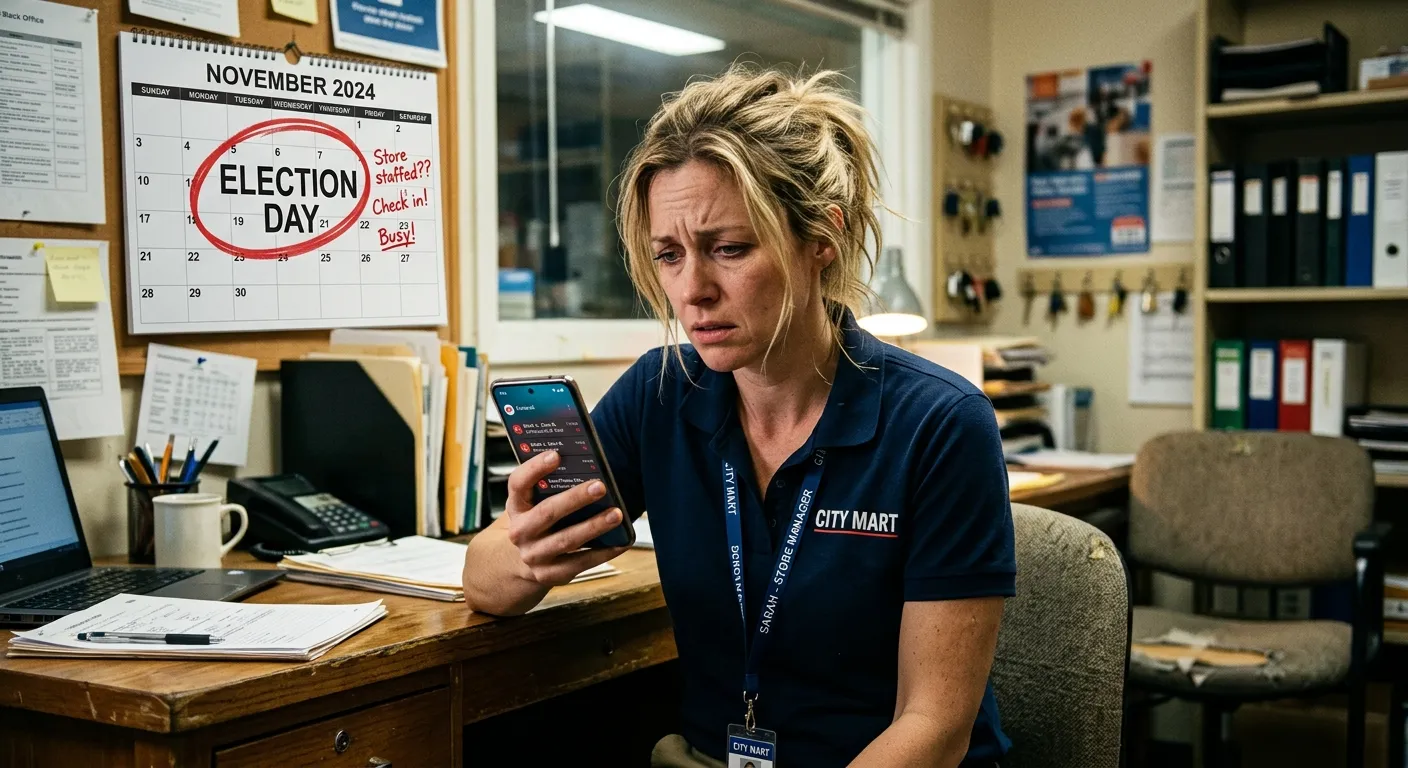
- Staffing Shortfall: 60% of in-store staff requested time off to vote, crippling floor coverage and online order fulfillment.
- Communication Bottleneck: Their single customer service line was overwhelmed with delivery queries, leading to a 15% increase in missed calls and a spike in negative social media comments.
- Lost Revenue: The inability to promptly answer"click-to-call" inquiries from the website directly resulted in an estimated £8,000 in lost sales over the 3-day peak election period.
The Strategic Response
For the upcoming election, Urban Goods implemented a dual-solution model:
- Proactive Staffing: They used a flexible staffing platform to hire four temporary associates two weeks in advance. Two covered the physical store, while two were trained on the e-commerce backend to handle packing and customer service overflow.
- AI Call & Chat Integration: They deployed an AI call-handling system configured with election-specific scripts. It answered all after-hours calls and provided real-time delivery status pulled from their courier API. The same AI powered a chat widget on their website.
The Measurable Outcome
100%
Call Answer Rate
Zero missed calls, even during peak hours.
+12%
Online Conversion
From handled"delivery time" inquiries.
£0
Overtime Costs
Temporary staff prevented burnout and overtime.
35 min
Avg. Callback Time
For complex queries, down from 4+ hours.
Advanced Configuration: Tailoring Your AI for Election-Specific Scenarios
Beyond basic call answering, modern AI systems can be finely tuned for the unique communication landscape of an election period. This goes far beyond a simple"we are open" message. Strategic configuration turns your AI into an intelligent communication hub that manages perception and provides tangible value.
1. Sentiment-Aware Routing
During elections, public sentiment can run high. An AI trained in sentiment analysis can detect frustration or urgency in a caller's tone and language.
- Action: Calls flagged as"urgent" or"frustrated" are immediately routed to a live human agent (or the most senior available temp staff), bypassing any queue. This de-escalates situations instantly.
- Example: A customer of a financial services firm calling about portfolio safety amid election promises would be routed directly to an advisor, building immense trust.
2. Dynamic FAQ Updates
Your AI's knowledge base should be a living document. In the week leading up to the election, inject anticipated Q&As.
- For a Logistics Company:"Are there delivery delays expected on polling day?" AI Response:"Our depots are operating as usual. For real-time tracking of your specific parcel, please provide your tracking number."
- For a Healthcare Provider:"Will my appointment be affected if staff are voting?" AI Response:"All scheduled appointments are confirmed. We have arranged staff coverage to ensure no disruption to patient care."
This proactive communication, powered by an intelligent business phone system, pre-empts uncertainty and positions your business as stable and reliable.
The Long-Term ROI: From Election Tactic to Core Business Infrastructure
The investment in flexible staffing and AI communication for an election period shouldn't be viewed as a one-off cost. When integrated permanently, these tools deliver continuous value, transforming a reactive tactic into a core competitive advantage.
Enhanced Employer Brand
By using temporary staff to cover voting leave, you demonstrate respect for your employees' civic duties. This boosts morale and retention. Furthermore, partnering with a quality staffing platform gives you access to a vetted talent pool for future growth.
Data-Driven Insights
AI call systems provide granular analytics. Post-election, you can analyze: Which questions were asked most? What were peak call times? This data is invaluable for forecasting staffing needs for future events, from elections to holiday sales, and informs your marketing strategy. It’s like having an AI receptionist that also functions as a market research team.
Permanent Cost Optimisation
The hybrid human-AI model optimizes labor costs long-term. Routine, repetitive inquiries are automated at a low marginal cost, allowing you to allocate human capital—both permanent and flexible—to revenue-generating activities and complex customer needs. This model is explored in depth for specific sectors like trade businesses.
"Preparing for the election wasn't just about avoiding disruption; it was the catalyst that pushed us to modernize our entire customer service operation. The AI and flexible staff we brought in are now permanent parts of our toolkit, driving efficiency every single day."
— Sarah Chen, COO of Urban Goods
Getting Started: Your 5-Week Implementation Timeline
Don't wait until the election is called. Follow this phased timeline to build your resilient operation seamlessly.
Week 1-2: Assessment & Planning
Conduct a communication audit. Identify peak call times, common inquiries, and key staff roles. Define your goals: Is it zero missed calls? 24/7 coverage? Set clear KPIs.
Key Deliverable: A detailed map of communication flows and vulnerability points.
Key Deliverable: AI system live with basic call answering and one key election FAQ flow configured.
Week 3: Technology Onboarding
Select and implement your AI call solution. Start with core functions: after-hours answering, basic call routing, and voicemail-to-text. Begin drafting election-specific script scenarios.
Week 4: Staffing Mobilisation
Post your temporary staffing needs. Vet and select candidates. Run a short, focused training session integrating them with your new AI system—clarifying when calls go to AI and when they are escalated to human staff.
Key Deliverable: Temporary staff contracted, trained, and ready. A clear escalation protocol is documented.
Key Deliverable: A full-system test confirming both AI and human elements work seamlessly. Team briefed and confident.
Week 5: Dry Run & Go-Live
Conduct a full stress test. Simulate high call volume and staff absence. Refine scripts and routing. Go live with your integrated system, monitor closely for the first 48 hours, and adjust as needed.